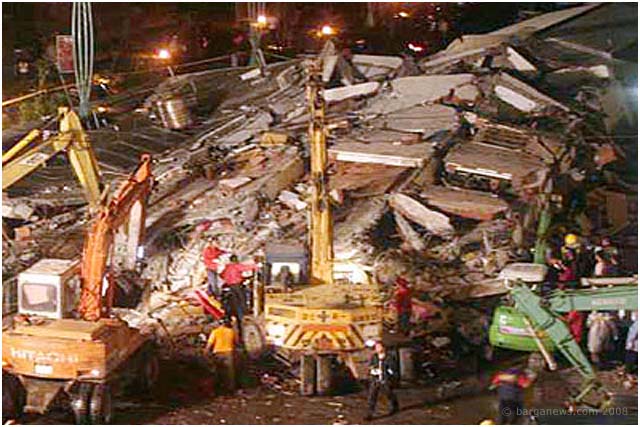
Amidst public mourning in China, the deadly earthquake of May 12 is assuming the force of a seismic equivalent to September 11, 2001 in the United States – a watershed test of national maturity in the face of crisis.
The test has already brought out the extraordinary best in many “ordinary†Chinese, much as the destruction of the World Trade Center did in New York firemen and cops. The 200 Chinese rescue workers buried in a mudslide Sunday bear awful testimony to that comparison.
Like the September 11 disaster, the earthquake is also severely testing the Chinese leadership, in ways that will extend far beyond the immediate crisis. What remains to be seen is whether Beijing will deal with the longterm challenge more competently than Washington did in the wake of 9-11 or Hurricane Katrina.
SPEED AT ANY COST
No disaster policy, however enlightened, can undo the the loss of an estimated 50,000 lives, many of them very young, a tragedy pictured in heart-rending photographs of collapsed schools and weeping parents that have gripped the world’s attention. But the nation’s leadership can insist on a hard look – a merciless and comprehensive self-examination – directed at policies leading up to this terrible test, and take steps to prevent such enormous losses in the future.
In China’s case, the unavoidable focus must be on the collateral dangers of a runaway economic boom, the annual double-digit growth that has transformed a Third World peasant society into a global manufacturing giant in less than a generation.
The earthquake, of course, was a natural event beyond human prevention. Yet all natural events in the modern world, especially in a country as dynamic as China, transpire in an increasingly artificial landscape – a landscape of ever-taller apartment complexes, ever-longer highways and ever-more gargantuan dams, all of them subject in principle to legally defined construction standards.
The enforcement (or neglect) of such standards can literally make the difference between life and death.
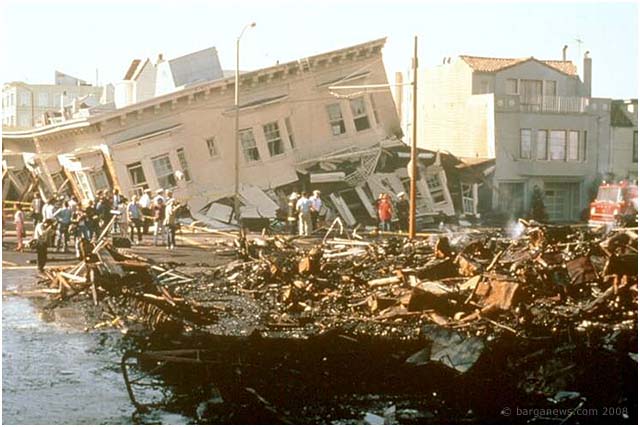
It explains why only 62 people were killed in San Francisco’s 6.9 Richter-scale trembler in 1989. At 8.0 on the Richter scale, the Sichuan quake was much more powerful than its California predecessor, but its epicenter was in a significantly less-densely populated region. Put brutally, many thousands of Chinese died for no good reason.
Within 24 hours of the quake, its survivors were beginning to voice charges that have been common, if discreetly ignored, knowledge for a decade. Construction standards in the People’s Republic have been far less compelling than the sheer pressure to build. Speed was everything, and in the race to create a prosperous new China, wealth rained down on contractors who cut critical corners on building materials, and on officials who were paid off to look the other way.
Survivors point out that schools and public housing collapsed within minutes in some towns, while Communist Party headquarters and other government buildings were left unscathed. To their powerful official occupants, construction standards mattered more than speed.
GROWING PAINS
The evidence of scofflaw building could not have gone unremarked by China’s top leaders on their nationwide tours.
Hu Jintao, General Secretary of the Communist Party, Chairman of the Central Military Commission and President of the People’s Government, is a graduate of the elite Tsinghua University Engineering School, China’s M.I.T., and served for nearly a decade as an official overseeing construction in the western province of Gansu, where conditions are very similar to those in Sichuan. Nor could the building collapses have surprised Premier Wen Jiabao, another engineer, trained at the equally elite Beijing Institute of Geology and serving for 18 years as an official in the Ministry of Land and Resources.

Even to a foreign journalist with no grounding in engineering or the construction trades, the perils were readily apparent on a 3,000-mile research swing across China a few years ago. Beijing and the rich coastal cities were one thing. They’d had their heedless boom earlier, and in many instances entire highrise districts had been torn down and rebuilt with thoughtful architectural plans, structural steel instead of cheap alloys and trustworthy concrete. As they grew wealthier, middle class residents in these cities developed the political clout necessary to bring down corrupt officials.
But the poorer Chinese far west, where the quake struck, put a visitor in mind of America’s rapidly developing western frontier 125 years ago. You wondered, passing through raw, ramshackle industrial belts where water buffalo roamed only a year or two earlier, if their cinder-bloc cities could withstand a strong wind much less a major earthquake.
The anology with 19th century America is pertinent. The marriage of official corruption and shabby building practices is endemic to economic booms. The growing pains of the United States in the Gilded Age, and of China today, were also experienced by Japan and West Germany in their rapid recovery from World War Two.
But at a certain point of development, growing pains must come to an end. Speed and crude wealth are no longer the sole criteria that matter. China’s east coast has reached that point. In the aftermath of May 12, can the central government keep pace?
A REVOLUTION? OR A TRAGIC PAUSE?
The early indications, in the ruins of Sichuan and in the corridors of government, are encouraging.
In stark contrast with typhoon-leveled Burma, where overseas assistance organizations were prevented from entering the country, expert Japanese, Taiwanese and South Korean rescue teams – representing China’s three most antagonistic Asian rivals – were admitted immediately.
The press, domestic and foreign alike, has been given the green light for full and unblinking coverage of the earthquake zone, including Tibetan-inhabited areas that have been strictly off-limits to the media since anti-government protests erupted there in March.
Questions are being publicly raised, even in government-controlled newspapers, about construction scandals and official malfeasance, about thousands of children who might have lived if their schools met legal standards.
These developments are not merely at odds with the paranoid, go-it-alone delusions that characterized Rangoon’s post-typhoon policies – and Washington’s after the 9-11 attacks and Hurricane Katrina. They are without precedent in China’s own recent history.
The weeks ahead will tell whether this marks a true turning point, a true maturing of China as a world power, or a brief moment of tragic sobriety. It would be unrealistic to expect that the earthquake alone will change everything, eliminating corruption, growth at any cost and autocratic government at a single massive stroke.
But it may be even more unrealistic, after three days of national mourning and reflection among 1.3 billion Chinese, to expect that nothing will change at all.
Frank Viviano – barganews staff reporter – World View CBS5
A Chinese teacher has been sent to a labour camp over his internet photographs of schools that collapsed in the Sichuan earthquake, a rights group said today.
Liu Shaokun was ordered to serve a year of “re-education through labour”, according to Human Rights in China. The system does not require a formal charge or criminal trial and is not subject to court appeals.
He is believed to be the third person held after posting material questioning why so many schools were destroyed in the May 12 earthquake, in which around 70,000 people died.
The authorities initially responded to a wave of public outrage by promising an inquiry into whether shoddy building work was linked to corruption.
But they have subsequently silenced critics, ordering the state media not to report on the subject and preventing parents from protesting.
“Instead of investigating and pursuing accountability for shoddy and dangerous school buildings, the authorities are resorting to re-education through labour to silence and lock up concerned citizens like teacher Liu Shaokun and others,” said Sharon Hom, executive director of Human Rights in China.
The group said that Liu, a teacher at Guanghan middle School in Deyang City, was detained on June 25 for “disseminating rumours and destroying social order.” His wife, who has not been allowed to see him, was told last week that he had been sent to a labour camp.
He had travelled through the quake zone taking pictures of the ruins of schools and circulating them on the internet, along with criticism of shoddy building work.
full article here
With astonishing, blunt cruelty, the Central Committee of the Chinese Communist Party has delivered a resounding “No!” to the rhetorical question I posed in my article. But in the long run, that is likely to prove a very self-destructive response to a tragedy that took so many lives for no good reason. The Chinese people are no longer passive cogs in a state machine, and there are growing signs of restiveness with autocratic and often corrupt rule. The Olympics, with their mindless national fervor and flag-waving, will still the anger for a time, but look for some serious domestic protest soon after — in the heartand of Han China, and not merely in Tibet and Muslim Xinjiang.