-
- "You've got to change your evil
ways, baby . . . "
-
- By Michael O'Malley and Dave Davis, barganews.com
reporters
-
- Working among buckets
and shovels in an old factory cellar spattered with casting plaster,
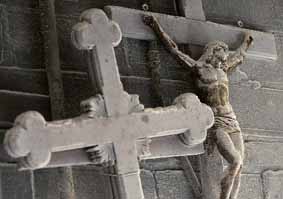
Giuseppe Guerriero tears open a mold that holds a body of Christ.
Upstairs, John Mazzolini is on the phone quoting a price to repair
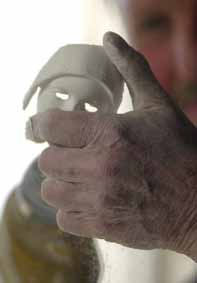
a Savior's finger, while Lino Nerici is sawing off a Virgin's
face so he can fit it with tiny glass eyes.
This is the business of Mazzolini Artcraft Co., a century-old,
family-operated statue maker on the near East Side in Cleveland,
Ohio, a city of about a half-million people in the United States.
Mazzolini Artcraft was founded by Italian immigrants from Sommocolonia,
distant relatives of Barga Vecchia's grocer, Andrea Mazzolini.
It is the largest distributor of religious statues in the United
States and one of the last of its kind, where workers make their
own molds and cast and paint by hand, employing Old World ways
of Italy.
 |
|
"I have to make a couple more arms and some wings,"
says Sicilian immigrant Guerriero, mixing another batch of milk-white
plaster. "These arms are going to the Sacred Heart of Jesus."
The business was started in 1904 by Italian immigrants, cousins
Primo and Alfonso Mazzolini, who first began making ornate plaster
light fixtures and ceiling medallions in a two-story shop on
the edge of the city.
"But, being Italian," said third-generation owner John
Mazzolini, "they made a few Madonnas on the side."
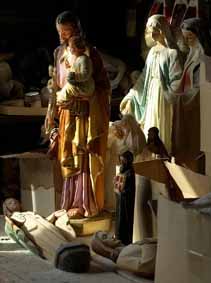
Today, the shop is cluttered with Madonnas, along with ranks
of plaster saints and angels that sell from $10 to $200.
"St. Mark with a lion," says Guerriero, opening another
mold on his basement work bench. "And this is a kneeling
Wise Man."
After the statues are untied from rope-bound molds, they are
set on shelves in a basement drying room for a day. An open wooden
elevator, manually raised and lowered by pulling a rope, then
lifts them to the third floor where they are sanded and painted
by hand.
-
"When I first started working here, I was messing up the
cheeks," said artist John Read, who applies skin tones and
primary coatings with an airbrush. "I used to make them
too red, too doll-like or clownlike."
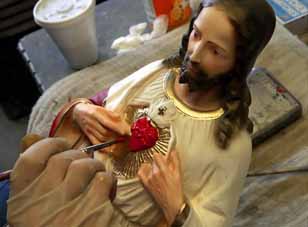
For detail work, the statues are moved from the airbrushing area
to a table where Katarina Terentiuk and Shannon English paint
lips, eyes and stigmata.
On a recent day, English, with a steady hand and a coffee can
full of skinny brushes, is busy with a cluster of open-armed
Sacred Hearts and Fatima Virgins. There are so many kinds of
Madonnas, she says, she can't remember all the names. Though
she can't forget the Mother of Sorrow, her least favorite figure.
"She's crying," says English. "And she has all
these swords through her heart. That bums me out."
Madonnas and Sacred Hearts are hot items at Mazzolini's. Though
just about any obscure saint can be found somewhere on a dusty
shelf - St. Peregrine, patron of people suffering with skin disease;
St. Barbara, patron of ammunition workers, gunners and stone
masons.
A saint holding a shovel; a saint clutching an arrow; sad-faced
saints; a headless saint; even Lazarus, on crutches with two
dogs at his feet licking wounds on his legs.
Mazzolini makes about 280 different figures, mostly religious,
though Abe Lincoln's bust and Bob Feller's pitching hand occasionally
pop up in the mix. Lincoln a popular early President who governed
the United States during the Civil War; Feller, a popular pitcher
for the Cleveland Indians baseball team in the 1950s.
Most of the products are immediately boxed and shipped to churches
and statue stores throughout the country. Some are stored on
basement shelves in marked boxes - Cabrini, Flute Boy, O.L. Lourdes,
Jude, Cow.
-
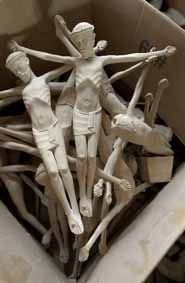
"I have no idea how many statues we make," said Mazzolini.
"Millions."
The shop, set back on a tree-lined street of century-old homes,
has a retail space on the first floor, featuring crucifixes,
rosaries and religious products from other companies.
Mazzolini is also a general contractor for church renovations
and religious artworks in bronze, wood and marble, working with
studios in Italy and Spain and selling pieces throughout the
world. "We're the largest religious statue distributor in
the United States, between what we make and what we import,"
Mazzolini said.
Statue repair is also a part of the business, fixing chipped
appendages and cracked halos. "Sometimes the fingers are
missing, sometimes the nose is broke," said Nerici, who
has worked at the shop for 45 years. "I fix everything."
-
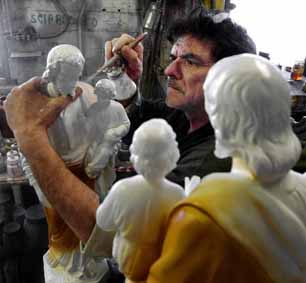
Fortunato "Castro" Gigli, who has worked at the shop
38 years since leaving Crasciana, unveils a life-size St. Francis
of Assissi to show off an arm he repaired. The brown-robed friar
stands, frozen, with outstretched arms showing stigmata wounds
on his hands. At his sandaled feet there is a human skull.
Gigli, too, is frozen, holding up the sheet of plastic, admiring
his plaster patch. St. Francis' eyes are cast downward. Gigli
is looking up.
A radio on a shelf above the saint is tuned to a pop station.
An old Santana song: "You've got to change your evil ways,
baby . . . "
-
-
-
-
- back
to the weekly columns index page
-
-
- back to

|
