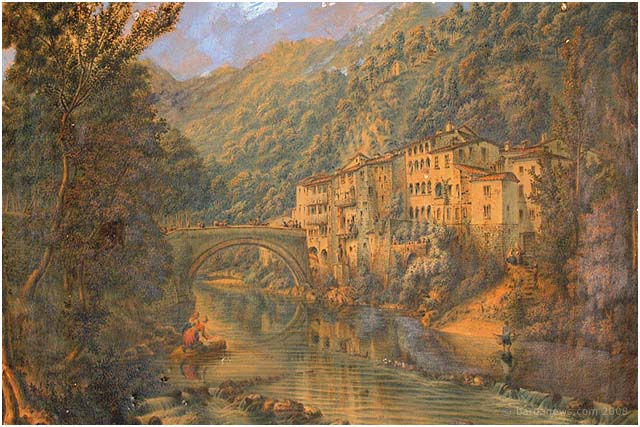
“Scusate ma questo ponte sul fiume potrebbe essere il Ponte di Catagnana?? E’ un acquerello del 1834 e forse il posto è un poco cambiato, o forse è Fabbriche di Vallico?
Questo pittore che si chiamava Louis Parez was called ha fatto anche una bella veduta della città di Barga assieme a questa e quindi dovrebbe essere dalle vostre parti – Cordialmente Museo Mario Praz Roma”
Could this be the bridge over the river at Catagnana just outside Barga ? It is a watercolour from 1834 maybe the place has changed slightly or maybe it could even be Fabbriche di Vallico?
The painter was called Louis Parez and he produced another view of the city of Barga together with this one and so maybe this image could be from around Barga – Museo Mario Praz Rome
An interesting question from the Museo Mario Praz in Rome. Most people have seen it so far think that Ponte di Catagnana is out of the question, many plump for Fabbriche di Vallico and a few even think it could be looking across the river down onto Castelnuovo Garfagnana. Anybody else have any other ideas ?
It’s definitely not Fabbriche – that’s arched on top whereas this is more or less flat. And I’m pretty sure you wouldn’t get fashionable ladies in pretty coloured dresses bathing up there in 1834 – everyone was too busy dying of cholera.
I would have thought that any go-ahead romantic painter at that time would head for Bagni di Lucca, which might make this Ponte a Serraglio. There’s an engraving in Evangeline Whipple’s old book “A Famous Corner of Tuscany” which looks a bit like this, with the path coming down to a little beach on the bank around that point. The buildings are a bit stylized in both but vaguely recognizable.
Here are the only modern pictures I can find. Look for example at the two little arches low down to the right of the bridge in your picture and in my second one. They’re sort of in the wrong place, but maybe they built a new bridge next to the old one? I’m in England now, unlike all my history of Bagni di Lucca books apart from Ms. Whipple’s, so I can’t verify this. Anyone like to blow my theory apart?
Anyway, just a thought.
EDIT; If you leave out the changeable human-constructed features in the painting – compare the angle and contours of the ridgeline above the bridge in the painting and in my bridge2.jpg. These, and the steeply upward-sloping feature in the forest above and to the right of the bridge, look pretty much the same in both.
I think the estimable Towler is quite right — it’s Bagni di Lucca, rendered in the overwrought landscape style of German Romanticism, much in vogue among Anglo-American painters in the early-to-mid 19th century (see the work of J.M. W. Turner, Frederick Church, Albert Bierstadt, Thomas Cole etc) Despite the French name, Louis Parez was active as a painter and popular illustrator mostly in Britain, ca 1820-1850.
Bagni itself was also in vogue in this same period, and would have been an ideal setting for that “emotional” tree in the foreground. Finally, there are the curve of the bridge and the proportionate relationship between it and the river’s width, both near-perfect matches with the central Bagni di Lucca bridge and the Lima River.
Bravo Towler!
It sure is nice to hear some friendly voices.