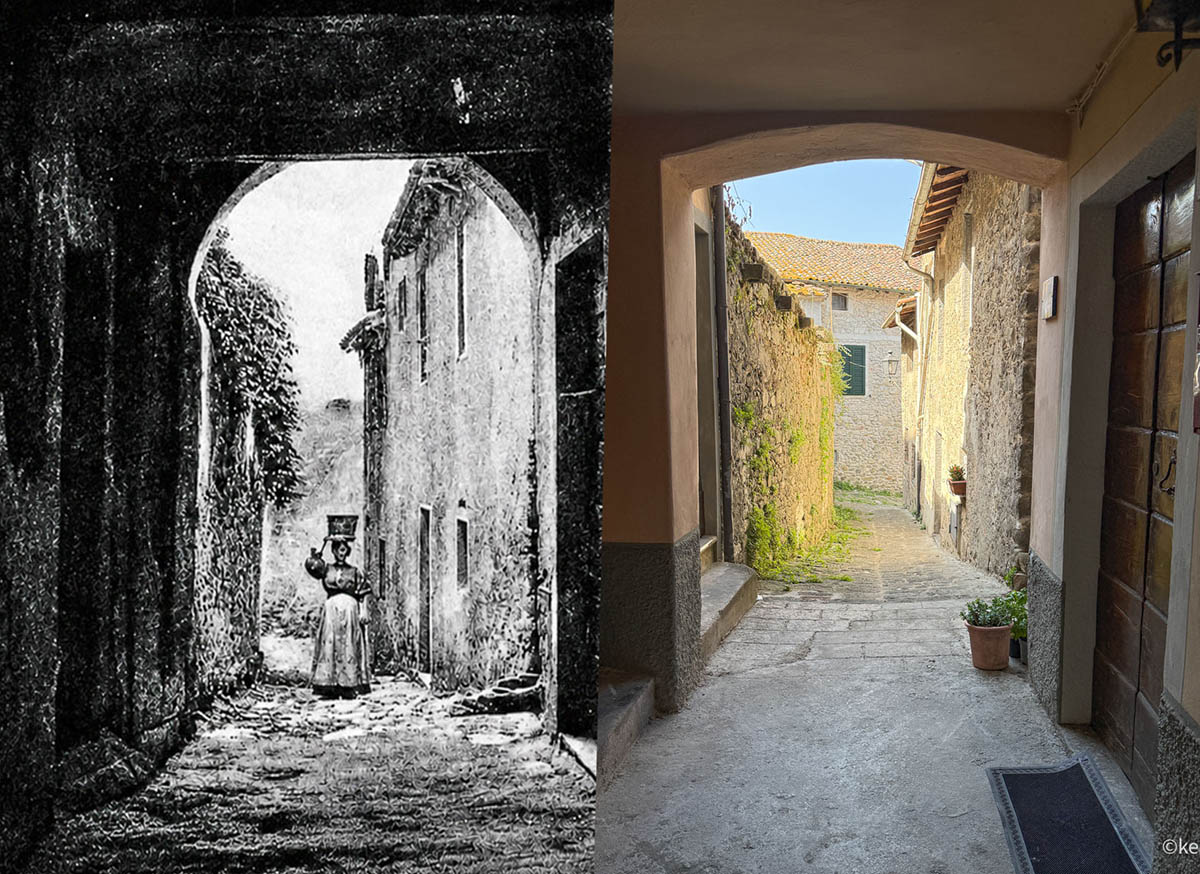
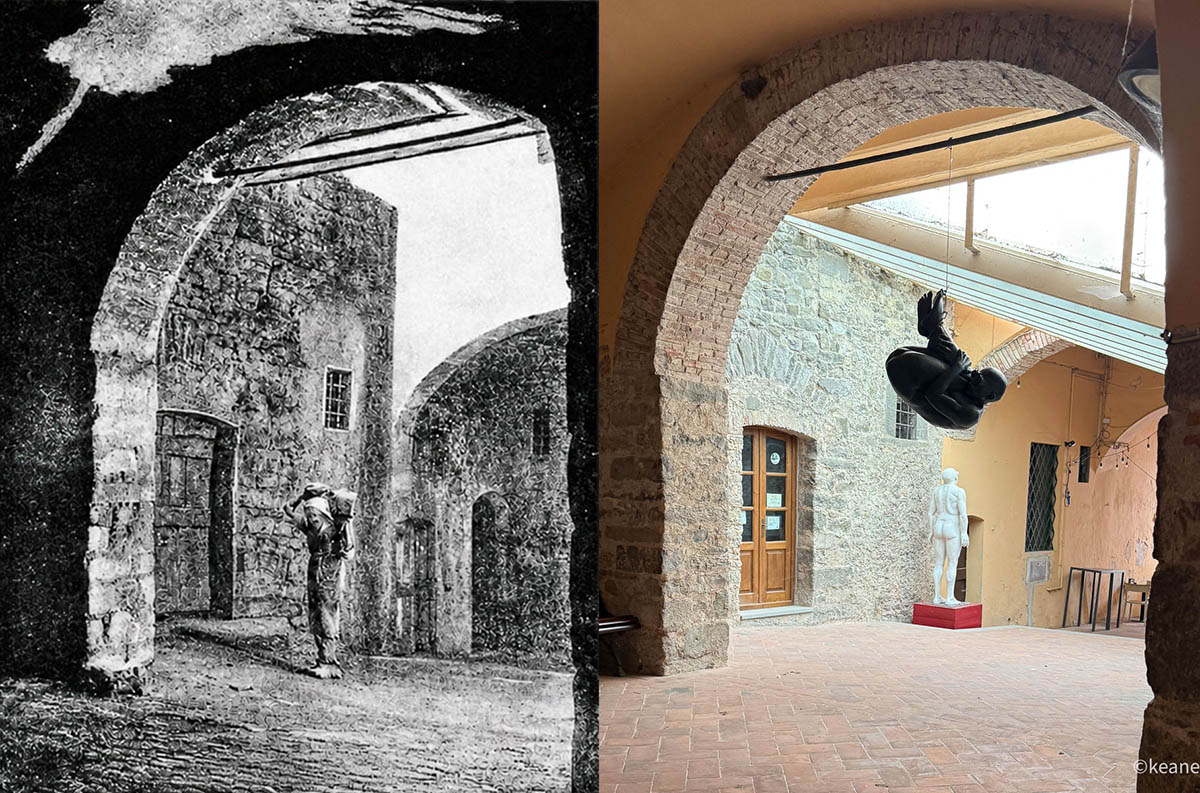
Few places reveal the passage of time quite as eloquently as Barga Vecchia. These two remarkable photographic comparisons, placing historic images alongside modern photographs taken from exactly the same viewpoints, show not only what has changed over more than a century, but also what has remained remarkably untouched.
The first comparison looks through the archway into Vicolo Orsini. In the early photograph, the wall on the left is almost hidden beneath luxuriant vegetation spilling down from a raised wooden pergola garden above. The foliage transformed the passage into one of the most picturesque corners of the city. Standing beneath the arch is a woman carrying a vessel balanced effortlessly on her head, an everyday scene from a time when life within the walls was shaped by routines that have long since disappeared.
Today the woman has gone, and the dense vegetation that once draped the wall has disappeared. The large square stone blocks that supported the timber pergola above are now fully visible, permanently revealing this fascinating piece of Barga’s architectural history. The archway, the surrounding buildings and the intimate scale of the passage remain instantly recognisable, linking the two photographs across more than a century.
The second comparison was photographed beneath the Volta del Menchi, the covered passage that today is home to Caffetteria La Volta. In the historic image, a solitary figure stoops beneath the weight of a heavy load while making their way through the archway, a reminder that these passages once formed part of the working life of the city. Every day they echoed with the movement of people carrying water, firewood, produce and supplies between the houses and piazzas.
Today the scene is very different. Where people once passed through carrying the necessities of everyday life, customers now sit outside Caffetteria La Volta, enjoying a coffee, a meal or conversation. Contemporary sculpture has replaced the burdened labourer of the old photograph, reflecting how this corner of Barga Vecchia has evolved from a place of daily work into one that is also associated with art, culture and social life. Despite these changes, the Volta del Menchi itself remains immediately recognisable, continuing to connect the present with the generations who passed beneath it long before us.
These photographs are more than a comparison between past and present. They remind us that Barga Vecchia is a living historic city where every archway, every passage and every stone still forms part of the same urban landscape that generations before us experienced. While the faces in the photographs have disappeared into history, the city itself continues to tell their story, preserving the character and atmosphere that make Barga Vecchia one of Tuscany’s most remarkable historic centres.




Pochi luoghi raccontano il trascorrere del tempo con la stessa efficacia di Barga Vecchia. Questi due straordinari confronti fotografici, che affiancano immagini storiche a fotografie moderne scattate esattamente dallo stesso punto di osservazione, mostrano non solo ciò che è cambiato nell’arco di oltre un secolo, ma anche ciò che è rimasto sorprendentemente immutato.
Il primo confronto guarda attraverso l’arco che introduce in Vicolo Orsini. Nella fotografia d’epoca, il muro sulla sinistra è quasi completamente nascosto dalla rigogliosa vegetazione che ricade da un giardino pensile sostenuto da una pergola in legno. Il fogliame trasformava questo passaggio in uno degli angoli più suggestivi della città. Sotto l’arco si distingue una donna che porta con naturalezza un recipiente in equilibrio sulla testa, una scena di vita quotidiana appartenente a un’epoca in cui la vita all’interno delle mura seguiva ritmi ormai scomparsi.
Oggi quella donna non c’è più e anche la fitta vegetazione che ricopriva il muro è scomparsa. I grandi blocchi quadrati di pietra che sostenevano la pergola in legno sono ora completamente visibili, rivelando in modo permanente questo affascinante elemento dell’architettura di Barga. L’arco, gli edifici circostanti e le proporzioni raccolte del passaggio restano immediatamente riconoscibili, creando un legame diretto tra le due fotografie a distanza di oltre cent’anni.
Il secondo confronto è stato realizzato sotto la Volta del Menchi, il passaggio coperto che oggi ospita la Caffetteria La Volta. Nella fotografia storica una figura solitaria avanza curva sotto il peso di un pesante carico, ricordandoci che questi passaggi facevano un tempo parte integrante della vita operosa della città. Ogni giorno risuonavano del continuo andirivieni di persone che trasportavano acqua, legna da ardere, prodotti e provviste tra le case e le piazze.
Oggi la scena è completamente diversa. Dove un tempo si passava trasportando tutto ciò che era necessario alla vita quotidiana, oggi le persone siedono all’esterno della Caffetteria La Volta, gustando un caffè, un pasto o semplicemente conversando. Al posto del lavoratore immortalato nella fotografia d’epoca si trovano oggi opere di scultura contemporanea, testimonianza di come questo angolo di Barga Vecchia si sia trasformato da luogo di lavoro quotidiano a spazio dedicato anche all’arte, alla cultura e alla socialità. Nonostante questi cambiamenti, la Volta del Menchi resta immediatamente riconoscibile, continuando a collegare il presente con le generazioni che vi sono passate sotto molto tempo prima di noi.
Queste fotografie sono molto più di un semplice confronto tra passato e presente. Ci ricordano che Barga Vecchia è una città storica viva, dove ogni arco, ogni passaggio e ogni pietra continuano a far parte dello stesso paesaggio urbano vissuto dalle generazioni che ci hanno preceduto. Mentre i volti ritratti nelle fotografie appartengono ormai alla storia, la città continua a raccontare le loro vicende, conservando quel carattere e quell’atmosfera che fanno di Barga Vecchia uno dei centri storici più straordinari della Toscana.