If the conditions are right and you are in the right place at the right time, it is possible twice a year, on the 11th – 12th November and the 30th – 31st January to see the doppio tramonto – the double sunset viewed from outside the Duomo in Barga Vecchia. (articles here)
 It does not happen every time as clouds often hide the sun at the last moment — but there is another natural event involving the sun which happens a few days before and after the double sunset, and that is just as spectacular and more often that not, totally ignored by most of the inhabitants or visitors to Barga .
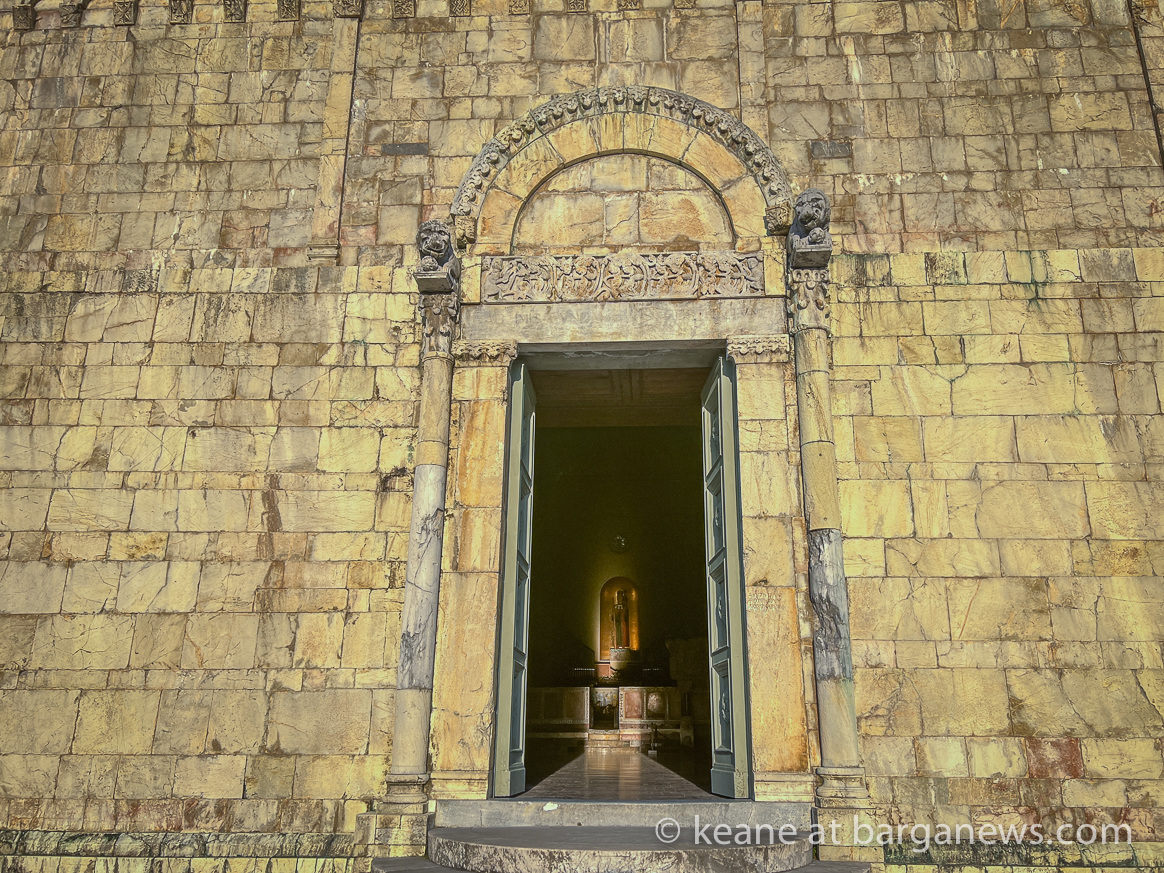
If conditions are right as the sun passes through the open door of the Duomo, it shines right down to the far end and lights up the enormous wooden statue of the saint, which then glows in the darkened space of the Cathedral.
This afternoon there were only a few people around and nobody in the Duomo as the sun lit up the statue but maybe over the next couple of days there is still time to catch this luminous event.
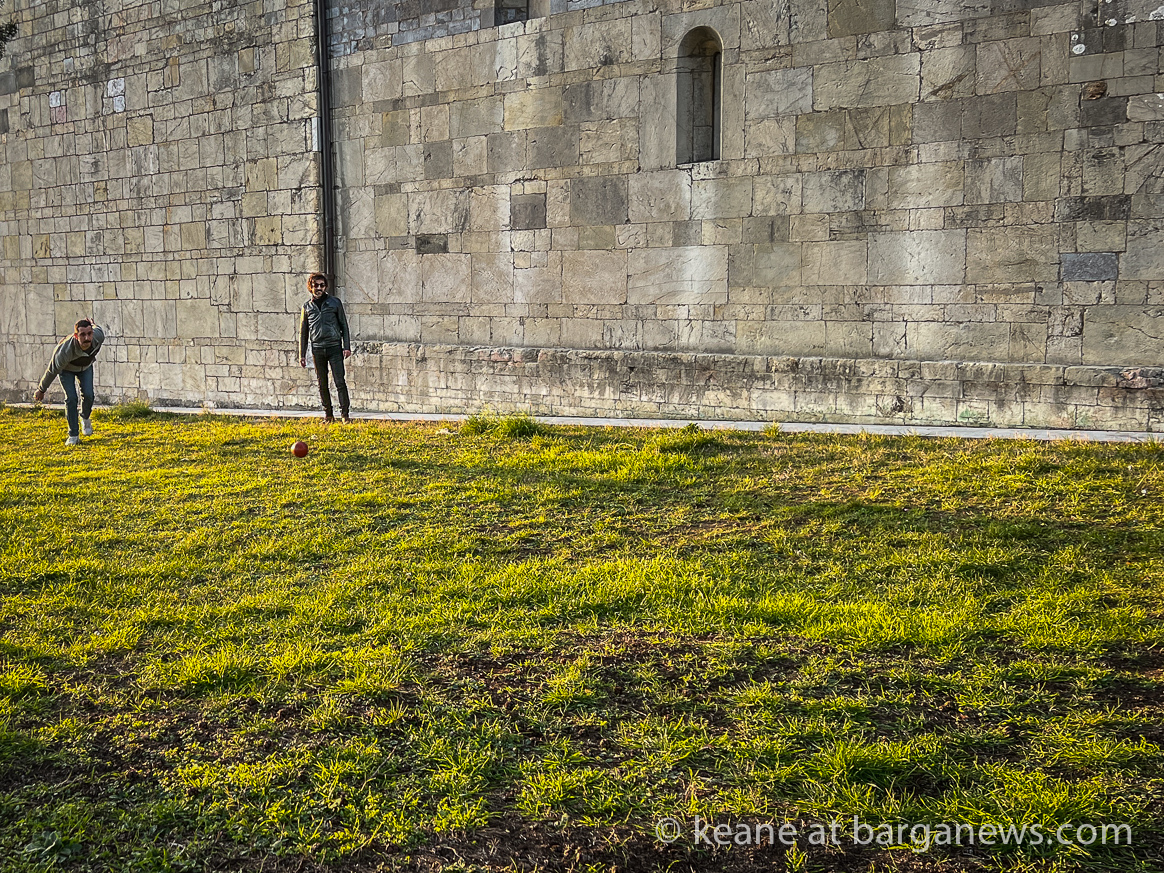
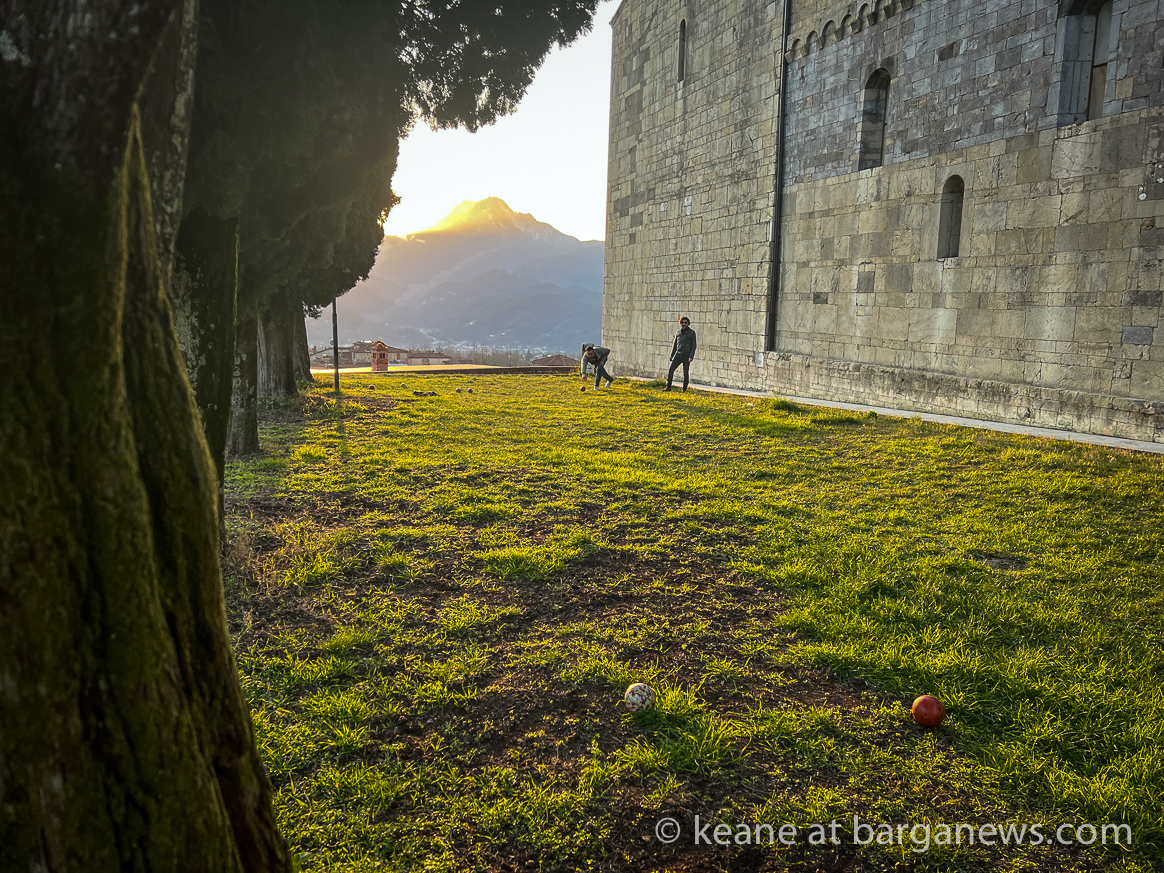
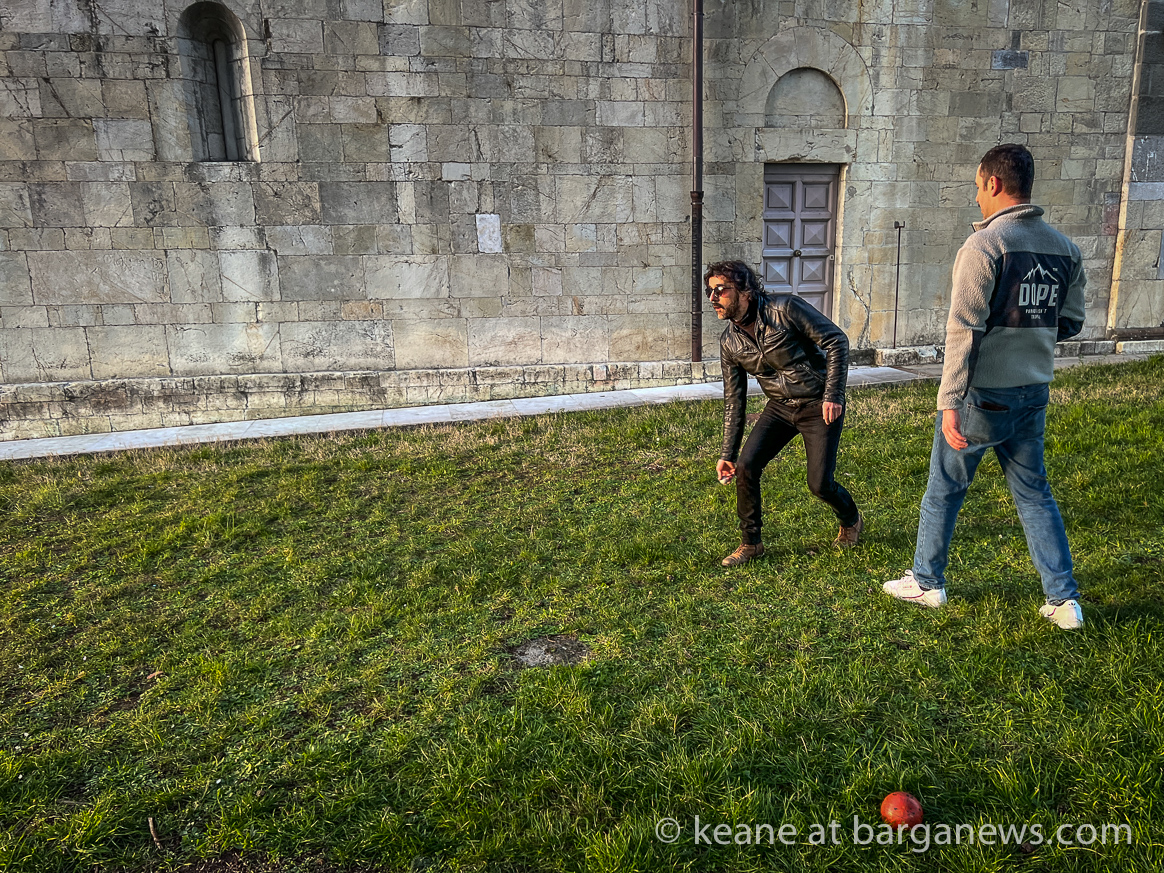
One of those people hoping to photograph the event – photographer Stefano Tommasi was actually at the Duomo at the right time but missed the moment as he was involved in another cultural event taking place on the grass outside the Duomo – a well fought game of Bowls with the chef Francesco Piacentini
Bocce, also spelled bocci, Italian bowling game, similar to bowls and boules.
Developed into its present form in Italy, it is closely related to British bowls and French *pétanque, with a common ancestry from ancient games played in the Roman Empire.
First form of regulation was described in the book “Gioco delle bocchie” by Raffaele Bisteghi in 1753.
Bocce is especially popular in Piedmont and Liguria and is also played in Italian communities in the United States, Australia, and South America. The governing organization is the Federazione Italiana Bocce. The first world championships were held at Genoa, Italy, in 1951.
The bocce court, or campo, is about 75 feet long by 8 feet wide (23 by 2.4 metres), with a level surface of sand or clay, enclosed with boarded ends and sides about 18 inches (45 cm) and 12 inches (30 cm) high, respectively. Each player or team in turn rolls or tosses four wooden, metal, or composite balls, called bocce, each 4–5 inches (10–13 cm) in diameter, toward a smaller ball, called the boccino or pallino. The object, as in the game of lawn bowls, is to bring the ball to rest nearer the pallino than an opponent’s ball, to protect a well-placed ball, or to knock aside an opponent’s ball. Rebounds from the side walls are permitted. At the end of a round, a side receives a point for every ball nearer the pallino than the nearest opposing ball. The game usually proceeds until one side has 12 points
*Pétanque was often played in Barga 20 years ago with a series of Pétanque International events 2002, 2003 and 2004 (full article with images here) involving players from Italy, America, Singapore, Canada, Ireland and Finland.
 |
 |
 |
 |

Se le condizioni sono giuste e sei nel posto giusto al momento giusto, è possibile vedere due volte l’anno, l’11-12 novembre e il 30-31 gennaio, il doppio tramonto visto dall’esterno del Duomo a Barga Vecchia (articoli qui).
Non accade ogni volta poiché spesso le nuvole nascondono il sole all’ultimo momento, ma c’è un altro evento naturale che coinvolge il sole che accade pochi giorni prima e dopo il doppio tramonto e che è altrettanto spettacolare e, nella maggior parte dei casi, completamente ignorato dalla maggior parte degli abitanti o visitatori di Barga.
Se le condizioni sono giuste mentre il sole passa attraverso la porta aperta del Duomo, brilla fino all’estremità opposta e illumina la enorme statua di legno del santo, che quindi brilla nello spazio buio della Cattedrale
Nel pomeriggio c’erano solo pochi persone in giro e nessuno nel Duomo mentre il sole illuminava la statua, ma forse nei prossimi giorni c’è ancora tempo per catturare questo evento luminoso.
Uno di quei persone che sperava di fotografare l’evento – il fotografo Stefano Tommasi – era effettivamente nel Duomo al momento giusto, ma ha perso il momento poiché era coinvolto in un altro evento culturale che si svolgeva all’esterno del Duomo sull’erba – una ben combattuta partita di Bocce con il chef Francesco Piacentini.
Bocce, anche scritto bocci, è un gioco italiano di bowling, simile a bowls e boules.
Sviluppato nella sua forma attuale in Italia, è strettamente legato ai bowls britannici e al francese *pétanque, con un’antenata comune dai giochi antichi giocati nell’Impero Romano.
La prima forma di regolamento è stata descritta nel libro “Gioco delle bocchie” di Raffaele Bisteghi nel 1753.
La bocce è particolarmente popolare in Piemonte e Liguria e viene anche giocata nelle comunità italiane negli Stati Uniti, in Australia e in America del Sud.
L’organizzazione che la governa è la Federazione Italiana Bocce.
I primi campionati del mondo si sono tenuti a Genova, Italia, nel 1951.
Il campo da bocce, o campo, è lungo circa 23 metri e largo 2,4 metri, con una superficie piana di sabbia o argilla, delimitata da estremità e lati rialzati di 45 cm e 30 cm rispettivamente. Ogni giocatore o squadra a turno tira o lancia quattro palle di legno, metallo o materiale composito, chiamate bocce, ciascuna con un diametro di 10-13 cm, verso una palla più piccola, chiamata boccino o pallino. L’obiettivo, come nel gioco delle biglie, è portare la palla a riposare più vicino al pallino di una palla avversaria, proteggere una palla ben posizionata o spostare da un lato una palla avversaria. Sono permessi i rimbalzi dalle pareti laterali. Alla fine di un round, un lato riceve un punto per ogni palla più vicina al pallino della palla avversaria più vicina. Il gioco solitamente continua fino a quando una parte ha 12 punti.
“20 anni fa, la pétanque veniva spesso giocata a Barga con una serie di eventi internazionali nel 2002, 2003 e 2004 (articolo completo con immagini qui) che coinvolgevano giocatori dall’Italia, America, Singapore, Canada, Irlanda e Finlandia.”