A photograph taken from Barga a few evenings ago sparked an interesting question. If we were to look towards the southern sky from the same position in Barga at exactly the same time every evening throughout the year, what pattern would the Moon trace above the mountains?
The answer is far more complicated–and far more beautiful–than many people might imagine.
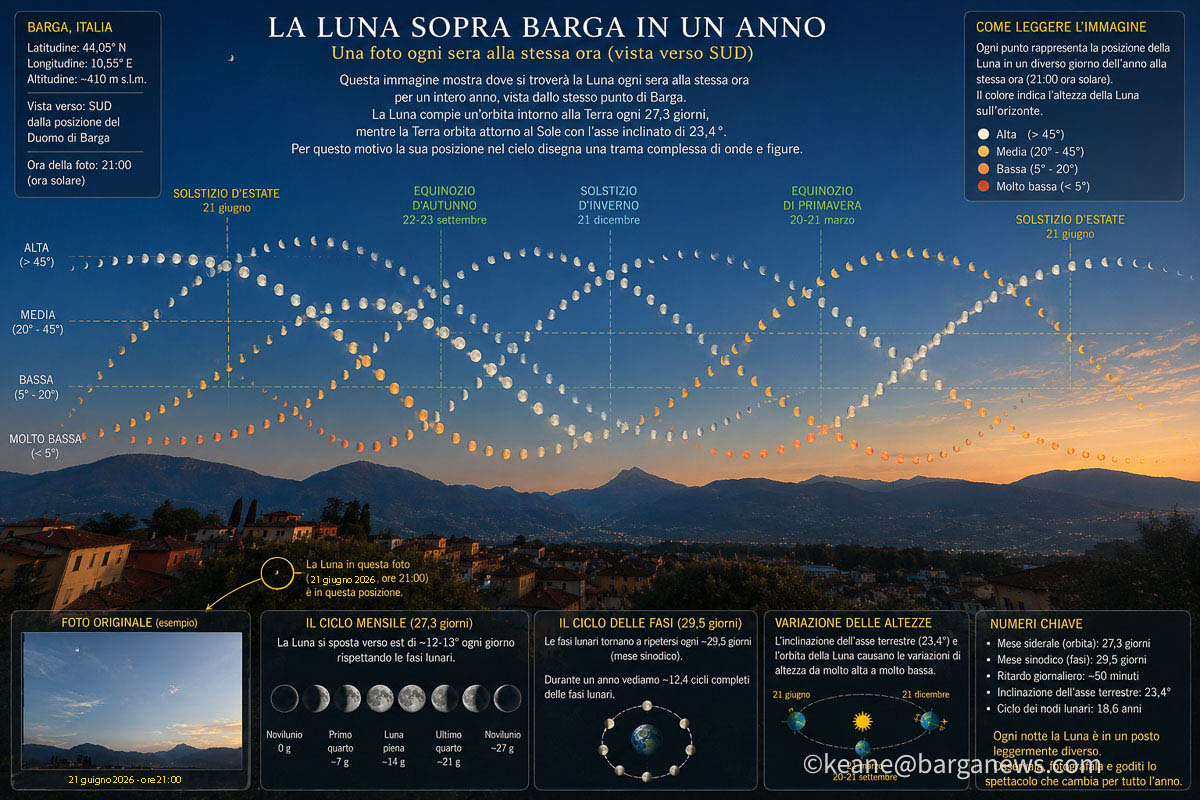
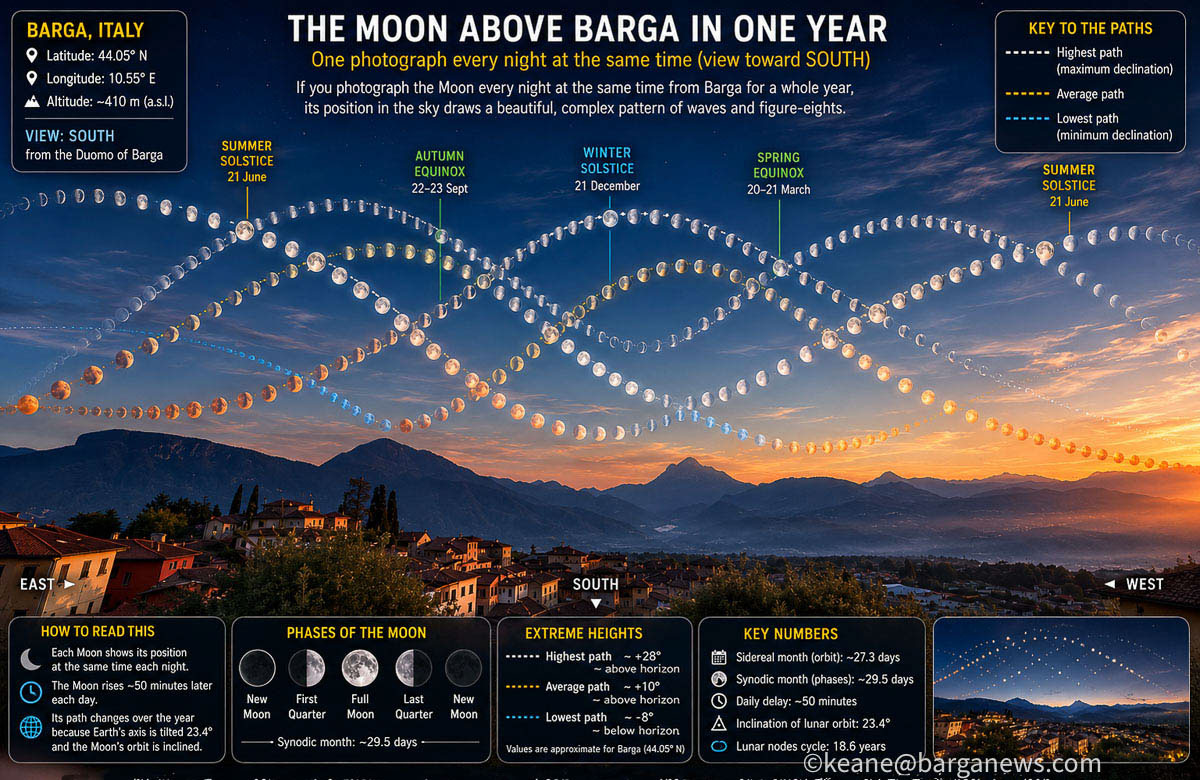
The two images accompanying this article attempt to visualise that journey. They show how the Moon’s position changes when viewed from the same location in Barga at the same time each evening throughout the year.
Rather than following a simple arc across the sky, the Moon traces a constantly changing series of waves, loops and crossings. Some nights it appears high above the mountains, while on others it remains much lower. At times it drifts towards the eastern side of the sky, while at others it appears further west. The familiar cycle of phases continues throughout, from crescent to full Moon and back again.
These changing positions are the result of several movements taking place simultaneously.
The Moon orbits the Earth approximately every 27.3 days. At the same time, the Earth is travelling around the Sun, while the Earth’s axis is tilted by 23.4 degrees. Together these motions create an ever-changing celestial dance that is far more complex than the simple rise-and-set motion we observe from day to day.
What makes these patterns so fascinating is that they remain largely invisible to us in everyday life.
We tend to think of the Moon as following the same route across the sky night after night. In reality, its position is constantly shifting. The changes are often small from one evening to the next, but over weeks and months they accumulate into a surprisingly intricate pattern.
The mountains surrounding Barga provide a natural frame for observing these movements. On some nights the Moon appears to skim low above the ridges, while on others it climbs high into the sky. Sometimes it seems to linger over one part of the horizon before gradually migrating elsewhere. Without careful observation, these subtle changes can easily pass unnoticed.
The images presented here attempt to reveal that hidden motion and to show that the Moon’s journey above Barga is not a simple path but a constantly changing tapestry written across the sky throughout the year.
The visualisations are based on astronomical principles and are intended to illustrate how the Moon’s position changes through the seasons when viewed from the same location in Barga at the same time each evening. They should be viewed as artistic interpretations of these movements rather than precise astronomical charts.




La Luna Sopra Barga — Un Anno Scritto nel Cielo
Una fotografia scattata a Barga qualche sera fa ha fatto nascere una domanda interessante. Se osservassimo il cielo verso sud dallo stesso punto di Barga, esattamente alla stessa ora ogni sera per un intero anno, quale disegno traccerebbe la Luna sopra le montagne?
La risposta è molto più complessa — e molto più affascinante — di quanto molti potrebbero immaginare.
Le due immagini che accompagnano questo articolo cercano di visualizzare quel viaggio. Mostrano come cambia la posizione della Luna quando viene osservata dallo stesso luogo di Barga, alla stessa ora ogni sera, nel corso di un intero anno.
Piuttosto che seguire un semplice arco nel cielo, la Luna descrive una serie di onde, anse e incroci in continuo mutamento. Alcune notti appare alta sopra le montagne, mentre in altre rimane molto più bassa. A volte sembra spostarsi verso la parte orientale del cielo, altre volte più verso ovest. Nel frattempo continua il consueto ciclo delle fasi, dalla sottile falce crescente fino alla Luna piena e poi nuovamente verso la falce.
Questi cambiamenti di posizione sono il risultato di diversi movimenti che avvengono contemporaneamente.
La Luna orbita attorno alla Terra in circa 27,3 giorni. Nello stesso tempo la Terra viaggia attorno al Sole e il suo asse è inclinato di 23,4 gradi. Insieme, questi movimenti creano una danza celeste in continua evoluzione, molto più complessa del semplice sorgere e tramontare che osserviamo quotidianamente.
Ciò che rende questi schemi così affascinanti è il fatto che, nella vita di tutti i giorni, rimangono in gran parte invisibili.
Tendiamo a pensare che la Luna segua sempre lo stesso percorso nel cielo notte dopo notte. In realtà la sua posizione cambia continuamente. Le variazioni da una sera all’altra sono spesso minime, ma nel corso delle settimane e dei mesi si accumulano fino a formare un disegno sorprendentemente complesso.
Le montagne che circondano Barga offrono una cornice naturale per osservare questi movimenti. In alcune notti la Luna sembra sfiorare le creste dei monti, mentre in altre sale molto in alto nel cielo. Talvolta pare indugiare sopra una parte dell’orizzonte per poi migrare gradualmente verso un’altra. Senza un’osservazione attenta, questi cambiamenti sottili possono facilmente passare inosservati.
Le immagini presentate qui cercano di rendere visibile questo movimento nascosto e di mostrare come il viaggio della Luna sopra Barga non sia un semplice percorso, ma un arazzo in continuo cambiamento scritto nel cielo nel corso dell’anno.
Queste visualizzazioni si basano su principi astronomici e hanno lo scopo di illustrare come la posizione della Luna cambi attraverso le stagioni quando viene osservata dallo stesso punto di Barga alla stessa ora ogni sera. Devono essere considerate come interpretazioni artistiche di questi movimenti piuttosto che come carte astronomiche precise.