Coming to Barga, it must be said that the idea of certain underground routes has always circulated in the collective imagination, the result of memories passed down orally from the past, though without the benefit of proper investigation. Nevertheless, we do have a written reference, which we can read in a book that helps introduce the subject.
This is the Guide to Barga by Pietro Groppi, published in 1901. The passage appears on page 64, where the author speaks about his own house, Casa Groppi, and formerly Casa Ricci, which rise from Via di Solco up to Piazza Angelio. It should be noted that from 1901, the year the guide was published, to today, the structures have remained largely unchanged, apart from the lowering of one floor of Casa Groppi.
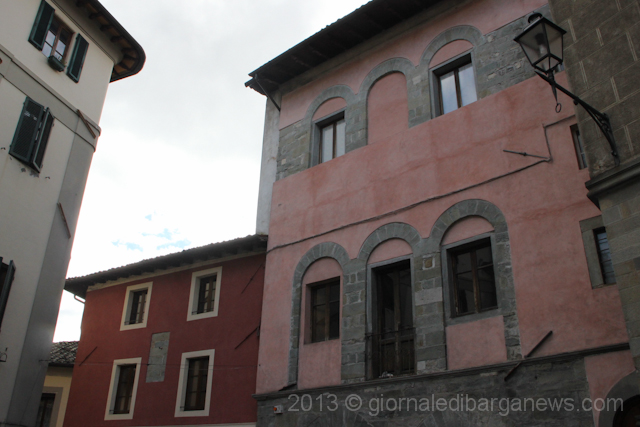
These are the two houses located at the end of Piazza Angelio when approaching from the Comune (as seen in the photograph). A residential complex which, as mentioned, drops down several storeys at the rear along Via di Solco, appearing from below almost like a tower—indeed, in the past it was intended to be even taller.
Here is what Groppi writes in his Guide to Barga about the two houses, which he suggests were once two of Barga’s towers.
Regarding Casa Ricci:
“This house is built in Via di Solco in pietra serena, with two large doorways featuring beautiful full arches; the same style is found in the windows overlooking the building.”
As for his own Casa Groppi:
“This house is built of stone, and it is said to have been a tower that dominated the passage of the Fosso di Solco together with the one already described belonging to Ricci. The foundations of this structure begin from Via di Solco; it is built of stone with two large doorways with fine full arches. The upper floors once had windows of the same style.”
And here we arrive at the point where Groppi gives us one of the very few written references to Barga’s ancient galleries:
“On the ground floor one can see the vestiges of an underground road heading north.”
From here, one might wish that Groppi had offered more—perhaps his own thoughts or deductions about its direction, even following the lines of local oral traditions.
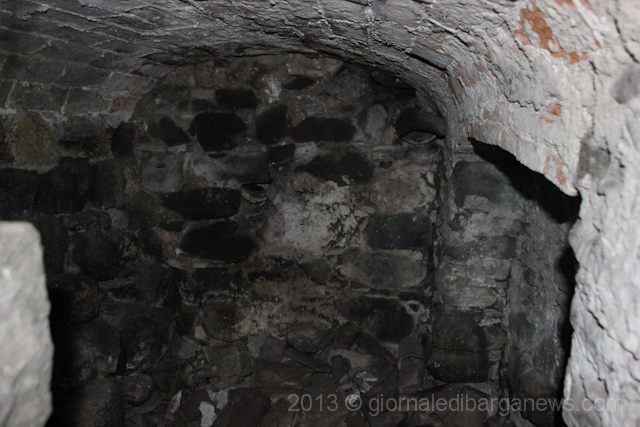
In any case, on the ground floor of the old Groppi palace, as can be seen from the images, there is a passage which, heading east, then turns south behind a large wall. Where does it end? What does it conceal? Or is it simply a void between structures?
When I took the photographs, I was accompanied by Mauro Moscardini of Barga, who had suggested the visit. Neither of us, however, had the courage to squeeze through that narrow opening to find out more, also because we were not properly equipped and it would have required some preparation.
In another image, we can see a further opening which appears to end in a niche carved—so it seems—into clay soil or pietra serena. Could this niche be the upper part of a descending passage beneath the base level of the old Groppi house? Perhaps the beginning of an unknown route, filled over the centuries with debris? It is a possibility to which we cannot give an answer.
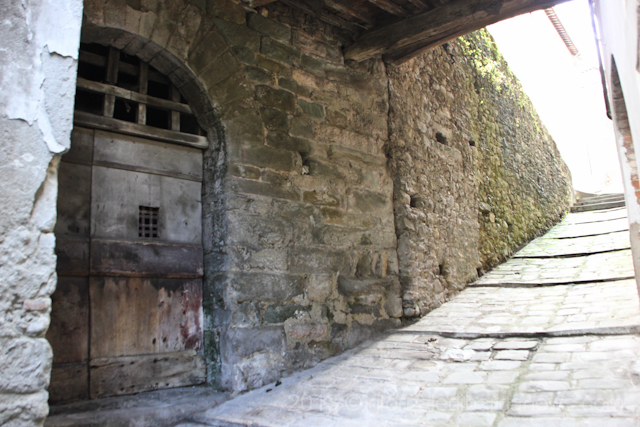
What can be said is that the Ricci and Groppi houses, at ground level along Via di Solco, are connected by four ancient portals, once all visible, aligned in a perfect straight line. Within them—especially in the Groppi section—there are structures of great interest to our discussion: openings that arouse considerable curiosity because of the mystery they contain.
Having considered this, we now turn to what has been preserved through oral accounts from reliable inhabitants of Barga regarding these underground galleries or tunnels.
We begin with Via di Mezzo, recalling what the archaeologist Antonio Mordini (1904–1975) reportedly told Commendator Pietro Marroni and his son Pier Carlo many years ago:
“There exists an underground route, which I (Mordini) have travelled several times, but whose entrances have now been sealed for safety reasons, connecting Palazzo Bertacchi with Palazzo Angeli.”
It should be remembered that the ancient Palazzo Bertacchi was built on the remains of a tower that once guarded the Solco Rovinoso—a channel which, beginning at the Fontana Maggio stream (formerly Vicinale), entered Barga in two branches. Between these natural channels there is still today an area known as the Bertacchi garden, where the outer façade of the palace drops more than ten metres from the level of Via di Mezzo.
Along this long façade, at ground level within the garden, there may once have existed an internal walkway allowing movement in defence of the ancient bastion. This structure—the garden resting at the visible base of the palace—was, and still is, enclosed by walls forming an inverted V shape that extends outward into the two natural channels marking the end of the Solco Rovinoso towards Barga.
This walkway—if we may use the conditional—could have extended as far as Piazza Angelio, as Mordini firmly believed. Indeed, if one observes the route of Via di Mezzo, which runs from Palazzo Bertacchi (now Casa Cordati) to Piazza Angelio, it follows closely the façades of the old palaces that line it. Of particular interest is the alignment of those buildings whose rear walls face the outside of the old castle, curving in a semicircle overlooking what is now the Bertacchi garden, once the defensive bastion.
In a similar way, the Ricci and Groppi houses we have already described also overlook this bastion. This suggests that the openings found within these buildings may once have served as access points to those passageways, possibly extending as far as Palazzo Angeli.
One might even be tempted to draw parallels with Coreglia and the antiquity of its tunnels—but it is best to stop here.
—– article by Pier Giuliano Cecchi
Underground Barga 1 – what lies beneath us?
Underground Barga 2 – the passageways of Casa Groppi, Casa Ricci and Via di Solco
Underground Barga 3 – the mysteries of Palazzo Giannetti and Via Marconi
Underground Barga 4 – the passageways of Piazza Angelio and the Augustinians
Underground Barga 5 – readers’ accounts




Venendo a Barga, dobbiamo dire che l’idea di certe vie sotterranee è sempre circolata nell’immaginario collettivo, frutto di memorie tramandate oralmente dal passato, però, senza la fortuna di un’indagine. Comunque ci resta un accenno scritto, che possiamo leggere in un libro che riportiamo per introdurci all’argomento.
Si tratta della Guida di Barga di Pietro Groppi edita nel 1901, e la citazione la troviamo a pag. 64 dove l’autore parla della sua casa Groppi e prima di Casa Ricci, che da via di Solco s’innalzano fino a Piazza Angelio. Qui diciamo che dal 1901, anno della guida, a oggi, le costruzioni sono rimaste tali, salvo l’abbassamento di un piano di casa Groppi.
Trattasi di quelle due case che stanno in fondo a piazza Angelio venendo da quella del Comune (nella foto). Un complesso abitativo che, come detto, sul retro sprofonda in via di Solco per diversi piani, da laggiù presentandosi alla vista come una torre, in antico voluta ancora più alta.
Ecco cosa dice Groppi nella sua Guida di Barga delle due case che vuole fossero state due torri di Barga;
Casa Ricci: questa casa è costruita in via di Solco in pietra serena con due gran portoni con bellissimi archi a sesto intero, così pure le finestre che prospettano il fabbricato.
Mentre per la sua casa Groppi: Questa casa è costruita in pietra, e si vuole che fosse una torre che dominasse il passaggio del Fosso di Solco con quella già descritta del Ricci. Le fondamenta di queste fabbrica partono dalla via di Solco ed è costruita in pietra con due gran portoni con bellissimi archi a sesto intero. Dello stesso stile erano le finestre dei piani superiori.
Eccoci al punto in cui Groppi ci dà uno dei pochissimi cenni scritti sulle antiche gallerie di Barga: Nel piano terreno si vedono le vestigia di una strada sotterranea in direzione Nord.
Da lassù non ce ne voglia Groppi se diciamo che di questa strada sotterranea poteva almeno dirci la sua idea, le sue deduzioni sulla direzione, magari sulla falsariga dei dettati popolari.
Comunque, nel piano terra dell’antico palazzo Groppi, così come possiamo vedere dalle immagini, c’è un passaggio che andando verso est gira poi a sud, dietro ad un grande muro. Dove finisce, cosa cela? O è solo uno spazio tra murature?
Quando feci le foto, ero in compagnia di Mauro Moscardini di Barga che mi aveva suggerito il sopralluogo, ma nessuno dei due ebbe il coraggio di infilarsi in quella strettoia per poterlo capire, anche perché non eravamo in un’adatta tenuta e c’era da conciarsi perbene.
In un’altra immagine possiamo vedere un altro pertugio che finisce, come pare, con una nicchia scavata, sembrerebbe, nel terreno argilloso o nella pietra serena. Potrebbe essere questa nicchia la parte alta di un passaggio a scendere sotto il livello della base dell’antica casa Groppi? Così iniziando un cammino sconosciuto e riempito con i secoli da vario materiale? Supposizione cui non possiamo dare risposta.
Quello che possiamo dire che le case Ricci e Groppi nel piano terra in via di Solco sono congiunte da quattro antichi portali, un tempo tutti a vista, che seguono una perfetta retta, al cui interno, specialmente per la parte di casa Groppi, ci sono quelle strutture molto intriganti circa il nostro discorso, gli accessi che incuriosiscono non poco per il mistero che racchiudono.
Osservato quanto detto, veniamo ora a quanto ci hanno lasciato di memorie orali persone di Barga degne di fede circa le gallerie o cunicoli sotterranei.
Iniziamo con via di mezzo, riportando cosa raccontava molti anni fa l’archeologo Antonio Mordini (1904-1975) al commendator Pietro Marroni e a suo figlio Pier Carlo: “Esiste un percorso sotterraneo, da me (Mordini) percorso più di una volta, ma i cui accessi adesso sono stati murati per motivi di sicurezza, che collega il Palazzo Bertacchi al Palazzo Angeli”.
Si ricorda che l’antico palazzo Bertacchi fu costruito sugli avanzi di una torre che stava in guardia del Solco Rovinoso che iniziando al rio Fontana Maggio, in antico Vicinale, con due rami s’insinuava in Barga. Tra i due canali naturali c’è ancora oggi un’area, detto orto Bertacchi, dove sprofonda, dal piano di via di Mezzo e per più di dieci metri, la facciata esterna dell’omonimo palazzo. In questa lunga facciata, nella parte a terra che si basa nell’omonimo orto, poteva esistere all’interno un camminamento per consentire gli spostamenti in difesa dell’antico bastione difensivo.
Quest’ultima struttura, l’orto che si appoggia alla base visibile del palazzo, ieri come oggi si cinge di mura formanti una V rovesciata verso l’esterno entrante nei due canali naturali costituiti dal termine verso Barga del Solco Rovinoso.Il ricordato camminamento, usiamo il condizionale, avrebbe potuto proseguire proprio fino a piazza Angelio, così come ricordava per certo Mordini. Infatti, se noi facciamo attenzione al tracciato di via di Mezzo che parte da palazzo Bertacchi, oggi Cordati, e va sino in piazza Angelio, vediamo che questo segue naturalmente le facciate degli antichi palazzi che vi si prospettano, particolarmente interessante per il nostro discorso l’andamento di quelli che hanno il retro sull’esterno del Castello e girano a semicerchio guardando l’odierno orto Bertacchi, ieri antico bastione.
Similmente guardano quel bastione anche le case Ricci e Groppi che abbiamo già citato e illustrato, con ciò volendo dire che quei ricordati pertugi esistenti in queste stesse case potrebbero essere stati, forse, l’accesso al proseguimento di quei camminamenti che avrebbero raggiunto anche Palazzo Angeli. Audacemente potremmo ritornare con il pensiero a Coreglia, all’antichità dei suoi cunicoli, ma qui è bene fermarsi.
—– article by Pier Giuliano Cecchi
Underground Barga 1 – what lies beneath us?
Underground Barga 2 – the passageways of Casa Groppi, Casa Ricci and Via di Solco
Underground Barga 3 – the mysteries of Palazzo Giannetti and Via Marconi
Underground Barga 4 – the passageways of Piazza Angelio and the Augustinians
Underground Barga 5 – readers’ accounts