Another memory comes from more recent times, when Mrs Cesira Cabrelli, whom I met at the Barga Library on Via Giannetti in the company of Professor Marta Rossi, began to tell me a fascinating story from her childhood, shared with her friends.
These were memories of games, including one in which they would squeeze with their friends through a small opening in the wall located on the left as you climb the steps leading from Piazza Angelio up to the Crocifisso.
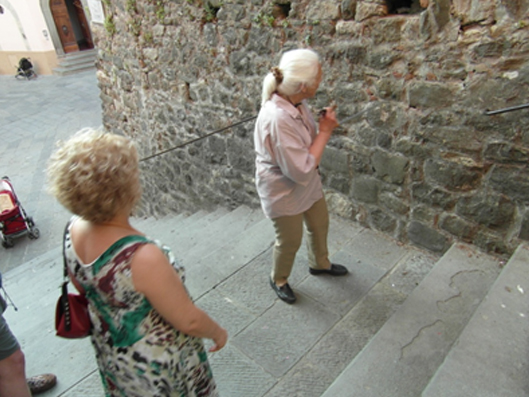
From the library we went to the site, and in the photograph we can see Mrs Cesira pointing with her stick to where that opening once was, through which they used to enter.
Inside began a tunnel that led them beneath Piazza Angelio. The game continued until, eventually, those responsible intervened and closed off the access. Cesira recalled that the tunnel extended in other directions as well, though she could not remember whether they had explored them.
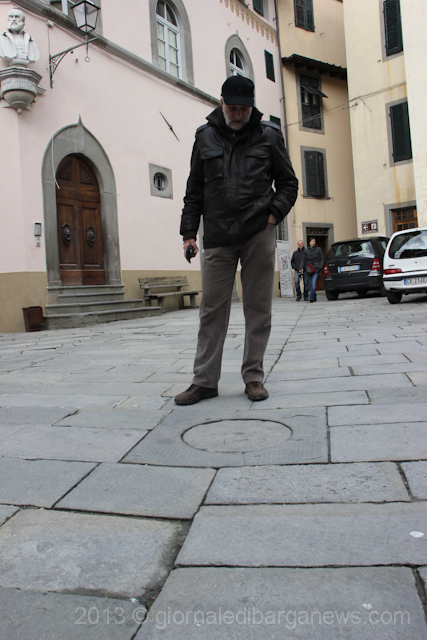
In the centre of the piazza we can still see a manhole covering an ancient cistern used to collect rainwater for the use of the inhabitants in times of need, especially for watering vegetable gardens. As a further historical note, it is recorded that Barga once had several such cisterns dating back to the Middle Ages, including the one in Piazza del Comune, into which water from the Loggia del Mercato was channelled. Another was located by the Duomo, on the Avelli side, and traces suggest the existence of yet another cistern on the Arringo lawn, both of which collected water from the Duomo roof.
Different from these cisterns were the public and private artesian wells, with which Barga had been well supplied since its earliest, uncertain origins. However, it should be noted that throughout the year the people of Barga could not always rely on them, since during the hottest summers the water levels would drop too low, sometimes producing muddy water that posed a health risk; in some cases, wells could even dry up completely, causing serious hardship for residents. This situation greatly concerned the Council of the Terra, until it succeeded in bringing water to Barga from the Rupine springs. The project began towards the end of the 15th century and was only completed in the early 17th century with the construction of the aqueduct that passes over the Ponte di Macchiaia.
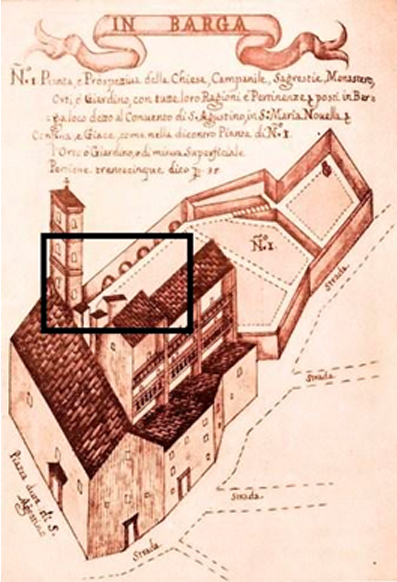
From the area of Mrs Cesira Cabrelli’s memories, we move slightly higher up, inside the ancient Augustinian Monastery, specifically in the space behind the house once inhabited by the pharmacist Vincenzo Simonini, who had his pharmacy on the ground floor in Piazza Angelio. The doctor himself recalled that in that space there was a tunnel or gallery heading in the direction of the Duomo. He explored this passage with others and, from the recollections that remain—now also preserved by Cinzia Giannoni, who heard them directly—it can be said that after several dozen metres they were forced to stop due to collapses. Based on the distance covered underground, they estimated that they had reached a point roughly beneath the Duomo, about 40 to 50 metres in a straight line from the entrance. In the drawing we can see the Monastery of St Augustine, with the area where the entrance to the gallery is thought to have been highlighted.
This image of the monastery was made in 1741 by the surveyor Domenico Cecchi of Castiglione Lucchese for the Terrilogio he produced on commission for the friars, illustrating their properties.
This ancient monastery, suppressed during the Leopoldine reforms in 1783, dates back at least to 1369, when the friars from the hermitages of St Margaret in Sommocolonia and St Ansano Giuncheto were received in Barga.
The area around the Duomo, due to its long history of habitation and its physical layout, leads us to further memories. For example, it was said that two tunnels began from Porta Reale or its vicinity: one to the left when exiting, which emerged beneath the curve at Bellavista on the road to Fornaci; and another, slightly to the left, which led towards the hills above the Hospital of St Francis—according to what could be understood from Mrs Cesira Cabrelli’s account—overlooking the road towards Hayange.
As a boy, I also heard it said that another tunnel reached Latriani, the valley below Barga behind the Duomo, specifically near Loppora. In this case, however, it is difficult to say whether this story was grounded in reality or simply the product of imagination—a vivid and fascinating creation of local folklore.
—– article by Pier Giuliano Cecchi
Underground Barga 1 – what lies beneath us?
Underground Barga 2 – the passageways of Casa Groppi, Casa Ricci and Via di Solco
Underground Barga 3 – the mysteries of Palazzo Giannetti and Via Marconi
Underground Barga 4 – the passageways of Piazza Angelio and the Augustinians
Underground Barga 5 – readers’ accounts




Altra memoria è di questi ultimi tempi, quando la signora Cesira Cabrelli, che incontrai alla Biblioteca di Barga di via Giannetti in compagnia della prof.ssa Marta Rossi, iniziò a raccontarmi una storia affascinante che visse da bambina con altri suoi amichetti.
Si tratta di ricordi di giochi, tra cui quello di infilarsi con gli amichetti del tempo in un pertugio aperto nel muro che si trova a sinistra salendo le scale che da piazza Angelio conducono al Crocifisso.
Dalla Biblioteca ci recammo sul posto e nell’immagine possiamo vedere la signora Cesira indicare con il bastone dov’era quel pertugio, da cui entravano.
Dentro iniziava un cunicolo che li portava sotto la piazza Angelio. Il gioco durò sino a quando, chi di dovere, non rimediò chiudendo quell’accesso. Ricordava Cesira che quel cunicolo andava anche in altre direzioni, ma non ricordava se l’avessero praticate.
Al centro della piazza possiamo ancora vedere un tombino che chiude un’antica cisterna per la conservazione dell’acqua piovana a uso dei castellani nei momenti di bisogno, specialmente per annacquare gli orti. Come successiva nota storica si riferisce che in Barga di cisterne ce n’erano diverse databili al Medievo, tra cui quella di piazza del Comune, in cui si facevano confluire le acque della Loggia del Mercato. Altra era sul Duomo, dalla parte degli Avelli, con tracce che ci portano all’esistenza di un’altra cisterna sul prato dell’Arringo, dove in ambedue confluivano le acque del tetto del Duomo.
Altra cosa rispetto alle cisterne erano i pubblici e privati pozzi artesiani, di cui Barga era ben fornita sin dall’ignota fondazione, osservando però che non per tutto l’anno i barghigiani potevano contare sulla loro vitale funzione, perché nelle estati più calde si abbassavano troppo e si poteva pescare anche acqua fangosa, mettendo a rischio la salute; in qualche caso qualcuno di essi poteva anche prosciugare, con grave danno degli abitanti. Uno stato delle cose che preoccupò non poco il Consiglio della Terra, fino a che non riuscì a portare in Barga l’acqua delle Rupine, il cui progetto ebbe inizio sul finire del sec. XV e si finì solo con gli inizi del XVII con la costruzione dell’acquedotto che passa sopra il Ponte di Macchiaia.
Dalla zona dei ricordi della signora Cesira Cabrelli, passiamo a poco sopra, all’interno dell’antico Monastero degli Agostiniani, precisamente nello spazio retrostante la casa che fu abitata dal farmacista Vincenzo Simonini, che al piano terra di piazza Angelio aveva l’omonima farmacia. Ebbene, ricordava lo stesso dottore, che in quello spazio c’era un cunicolo o galleria che andava in direzione del Duomo. Questa galleria fu da lui praticata con altre persone e dai ricordi rimasti, patrimonio oggi anche di Cinzia Giannoni che direttamente li udì, si può dire che dopo diverse decine metri dovettero fermarsi di fronte a dei crolli. Da quanto camminato lì sotto quantificarono la fermata circa sotto il Duomo, distante in linea d’aria dall’ingresso circa 40 o 50 metri. Nel disegno possiamo vedere il Monastero di S. Agostino, dove abbiamo evidenziato l’area in cui si presume esistesse l’accesso alla galleria.
Questa immagine del Monastero fu eseguita nel 1741 dal perito Domenico Cecchi di Castiglione Lucchese per il Terrilogio che eseguì su commissione di quei frati e illustrante i beni da loro posseduti.
Quest’antico Monastero, soppresso con le riforme Leopoldine l’anno 1783, risaliva almeno al 1369, quando i frati degli eremi di S. Margherita a Sommocolonia e S. Ansano Giuncheto, furono accolti in Barga.
L’area circostante il Duomo, per l’antichità abitativa e la sua conformazione, ci dà l’abbrivio ad altre memorie. Per esempio, che da Porta Reale o vicinanze prendessero avvio due cunicoli. A sinistra uscendo che andava a sboccare sotto il curvone di Bellavista, sulla via che va Fornaci; leggermente a sinistra l’altro che andava nei poggi sopra l’ospedale di S. Francesco, a quanto capì dal racconto della signora Cesira Cabrelli, in quelli che si affacciano sulla via Hayange.
Da ragazzo sentivo narrare che anche in Latriani, la valle sottostante Barga che sta dietro al Duomo, precisamente vicino alla Loppora, arrivava un altro cunicolo. In questo caso non saprei proprio dire se tutto questo racconto fosse stato il frutto della fantasia, un’immaginifica e affascinante creazione popolare.
—– article by Pier Giuliano Cecchi
Underground Barga 1 – what lies beneath us?
Underground Barga 2 – the passageways of Casa Groppi, Casa Ricci and Via di Solco
Underground Barga 3 – the mysteries of Palazzo Giannetti and Via Marconi
Underground Barga 4 – the passageways of Piazza Angelio and the Augustinians
Underground Barga 5 – readers’ accounts