In any case, the mysteries of Barga do not end here, and as another example we can mention Palazzo Giannetti, now home to the Biblioteca Comunale Fratelli Rosselli, situated along the western edge of the Castello of Barga.
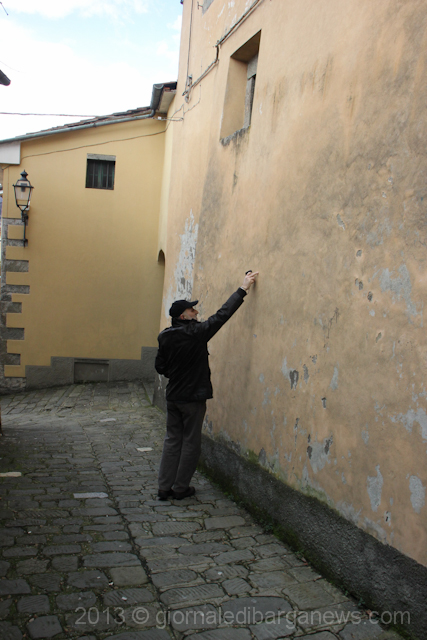
Here, on the northern side, at ground level along Vicolo Pierotti, there exists what appears not to be a true floor at all. In fact, the living quarters and storerooms begin only from the first floor (see photo), while below one can see a ground level without entrances, like a wedge-shaped base upon which the building stands. This structure was clearly designed to compensate for the slope of the terrain, allowing the palace to rest on a level surface, particularly along the north–south axis described.
In practice, this masonry wedge runs the entire length of Vicolo Pierotti—about twenty metres—and within it there appears to be a low doorway, walled up at some unknown time. What lies behind it, and why was the door sealed without any visible alternative means of access?
The rooms of Palazzo Giannetti above this mysterious structure were, in part, once used by my family, so I spent a great deal of time there. I can say that in our section there was a hatch, similar to a manhole, which led down into a dark cistern. As a boy I once leaned inside, but could see very little. There is also a large two-chamber well, and beneath another cover, a stone basin carved directly into the rock.
My curiosity was fuelled by having heard it said that from these rooms one could descend further, into the lower level beneath, but I never understood from where such access might have been gained—and certainly not through that cistern.
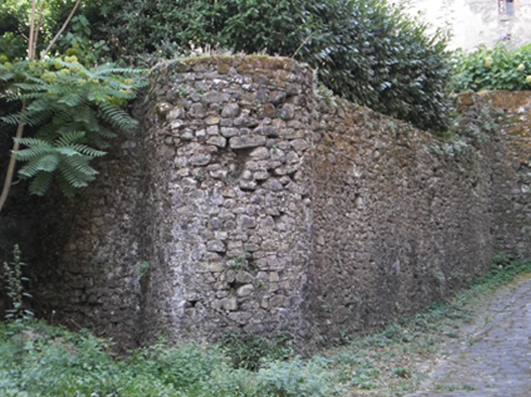
In any case, assuming there once was an entrance, and given that we are only about ten metres from the ancient walls that once ran along what is now Via Marconi, rising towards the Fosso, could there have been some kind of gallery connecting the two?
This idea was reinforced by Mr Tonacci, who lives in America but owns a house in Barga not far from Palazzo Giannetti—the one with a terrace overlooking Via Marconi, above the Pieri shop.
Tonacci had read an article of mine published last year on Barganews, in which I discussed, among other things, the small postern openings in Barga’s walls that supplemented the main gates. As he has cellars beneath street level in his Barga house, with a particular access point leading directly towards the walls of Via Marconi, he wrote to me suggesting that, during his next visit, he would like to meet and discuss the matter. His interest led me to reconsider what I knew about Palazzo Giannetti, and beyond what we concluded—essentially the sharing of an old map of Barga—it becomes clear that the idea of ancient underground routes leading out from the Castello is not mine alone, but part of a wider, shared perception, suggested by certain structural details.
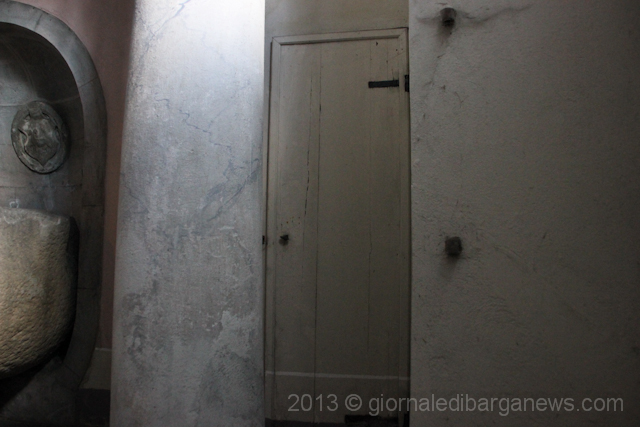
Just above Palazzo Giannetti, on Via Marconi, stands Palazzo Salvi (formerly Niccoli and Carlini). At its entrance on the street, immediately to the right, there is a small door (see photo) leading into what appears to be a gallery. It has been suggested that this might reach as far as Porta Reale, but this is unlikely. It probably dates instead to the 19th century, when the palace belonged to the Carlini family, one of the most prominent families in Barga, whose ancestors had obtained Florentine citizenship in the 16th century.
Looking at the facts, around 1830, when the road from the Fosso to the Giardino was constructed, work also affected a Carlini property outside their palace, now Palazzo Salvi. Within this property was a well that had once belonged to the people of the Borgo quarter, later passing to the Carlini and Manfredini families (the latter lived slightly lower down, in what is now the house of Paola Turri).
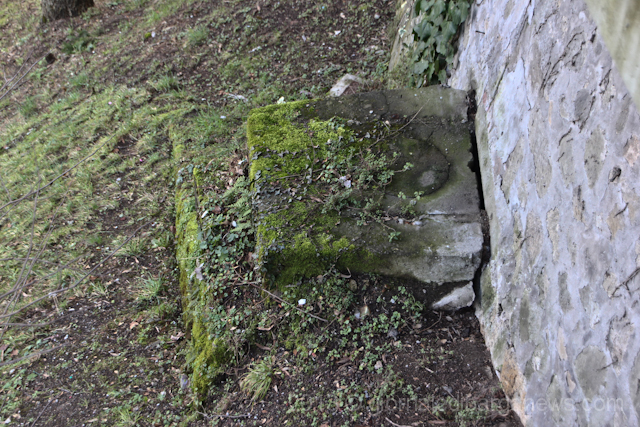
The Carlinis had direct access to this well from their palace, but the construction of the new road interrupted this connection. They lodged formal complaints, and the Comune granted them permission to build a gallery passing beneath the road. The well can still be seen today when walking up Via Marconi, just below the second bend, directly opposite Palazzo Salvi. Leaning over the railing, one can see below a manhole covering it, with steps alongside providing access.
As a final note, it is said that in various underground levels of the Castello of Barga, one can still see—or could once see—strange structures, such as staircases descending even further below. Signs of a past that has been little, if at all, investigated. What remains are memories, some of which we have attempted to document in this article, written with the aim of encouraging further exploration.
—– article by Pier Giuliano Cecchi
Underground Barga 1 – what lies beneath us?
Underground Barga 2 – the passageways of Casa Groppi, Casa Ricci and Via di Solco
Underground Barga 3 – the mysteries of Palazzo Giannetti and Via Marconi
Underground Barga 4 – the passageways of Piazza Angelio and the Augustinians
Underground Barga 5 – readers’ accounts




Comunque i misteri di Barga non finiscono qui e per altro esempio citiamo Palazzo Giannetti, sede della Biblioteca Comunale Fratelli Rosselli, inserito al margine occidentale del Castello di Barga. Qui, nella parte che affaccia verso nord, a terra in vicolo Pierotti, esiste un piano che non è tale. Infatti, la parte abitativa, con fondi, inizia solo al primo piano (vedi foto), e sotto, appunto, si può vedere il piano terra che è senza ingressi, come un basamento a forma di zeppa su cui si erge lo stabile, utile a suo tempo per ovviare al dislivello del terreno e così basare il palazzo su di un piano livellato, nel particolare descritto che va da nord a sud.
In pratica la zeppa muraria corre per tutta la lunghezza di vicolo Pierotti, circa venti metri, in cui c’è il sembiante di una bassa porta murata chissà quando. Cosa c’è lì dentro e perché fu chiusa la porta senza un’altra evidente soluzione per entrarvi?
I fondi di Palazzo Giannetti, superiori a questa misteriosa struttura, in parte erano stati concessi alla mia famiglia, quindi furono da me molto frequentati e posso dire che nel nostro c’era una botola, simile a un tombino, che immetteva in una buia cisterna. Da ragazzo ci infilai la testa dentro ma vidi ben poco. C’è anche un pozzo a due camere di grande capacità e sotto un tombino una vasca scalpellinata in pietra.
La curiosità fu dettata dall’avere sentito dire che da questi fondi si poteva scendere sotto, nella parte del piano a terra, ma non ho mai capito da dove e senz’altro l’accesso non poteva essere da quella sorta di cisterna.
Comunque, ammesso ci fosse stato un ingresso, una volta lì sotto, dato che siamo a circa 10 metri dalle antiche mura che passavano nel mezzo dell’attuale via Marconi che sale al Fosso, poteva esserci una sorta di galleria che le raggiungesse?
In questa idea mi ci mise il signor Tonacci, il quale vive in America, ma a Barga possiede una casa poco distante da Palazzo Giannetti, quella che ha il terrazzo che prospetta su via Marconi, sopra la bottega del Pieri.
Tonacci aveva letto l’anno passato un mio articolo pubblicato sul barganews, in cui, tra l’altro, parlavo delle antiche porticciole esistenti nelle mura di Barga a sussidio delle più grandi. Ebbene, avendo in questa sua casa barghigiana delle cantine sotto il piano stradale con un particolare accesso diretto verso le mura di via Marconi lì a un passo, per e-mail, mi disse che alla sua solita venuta a Barga avrebbe voluto incontrarmi per parlarne. Questa sua attenzione mi portò immediatamente a riconsiderare quanto sapevo di Palazzo Giannetti e di là da quanto concludemmo, consistito nel consegnargli un’antica mappa di Barga, l’interessamento di Tonacci ci fa capire che non è solo mia l’idea di antiche vie sotterranee che dal Castello conducessero fuori, ma patrimonio più ampio e percepito dall’evidenza di certi particolari costruttivi.
Poco sopra Palazzo Giannetti, in via Marconi, troviamo Palazzo Salvi, ieri Niccoli e Carlini, nel cui ingresso sulla via ricordata, subito a destra, presenta una piccola porta (nella foto) che conduce a una sorta di galleria. Si vorrebbe che questa arrivi sino a Porta Reale, però la storia non parrebbe questa e, forse, è risalente al sec. XIX, quando il palazzo era dei Carlini, una delle più notevoli famiglie di Barga, i cui antenati, nel corso del sec. XVI, avevano ricevuto la cittadinanza fiorentina.
Entrando nei fatti, quando circa l’anno 1830 si dette inizio alla strada che dal Fosso andava al Giardino, si dovette intervenire anche su un possedimento dei Carlini esterno al loro palazzo, oggi Salvi. In questo bene avevano il possesso di un pozzo, anticamente appartenuto al popolo del quartiere di Borgo, poi divenuto dei Carlini e dei Manfredini, quest’ultimi abitavano un poco più sotto, nella casa che oggi è di Paola Turri.
Uscendo dal palazzo i Carlini avevano l’accesso diretto al pozzo (nella foto), che il passaggio della nuova strada andava a interrompere. Fecero dei giusti reclami e dal Comune fu loro accordato il permesso di costruire una galleria che passava sotto la strada. Il pozzo è ancora visibile salendo via Marconi precisamente sotto la seconda curva, di fronte al palazzo Salvi. Sporgendosi dalla ringhiera vediamo lì sotto una sorta di tombino che lo chiude, con accanto delle scalette che vi consentono la salita.
Come nota terminale si dice che in vari piani interrati del Castello di Barga ancora oggi si possono vedere, o si sono osservate nel passato, strane strutture, come scale che scendono ancora più in basso. Segni di un passato poco, anzi, quasi per niente indagato. Di ciò sono rimasti ricordi che, almeno qualcuno, abbiamo cercato di documentare con quest’articolo, scritto con l’intento di stimolare un’eventuale indagine.
—– article by Pier Giuliano Cecchi
Underground Barga 1 – what lies beneath us?
Underground Barga 2 – the passageways of Casa Groppi, Casa Ricci and Via di Solco
Underground Barga 3 – the mysteries of Palazzo Giannetti and Via Marconi
Underground Barga 4 – the passageways of Piazza Angelio and the Augustinians
Underground Barga 5 – readers’ accounts