With the publication of the first article on the Mysteries of Barga, several people from Barga not only expressed their appreciation for the idea, but also began suggesting others—always connected to tunnels—some reinforcing the notion with the phrase: beneath Barga, the historic centre “is like a Swiss cheese”. It therefore seems worthwhile to present what has been told to me, as it adds further fascination to the subject.
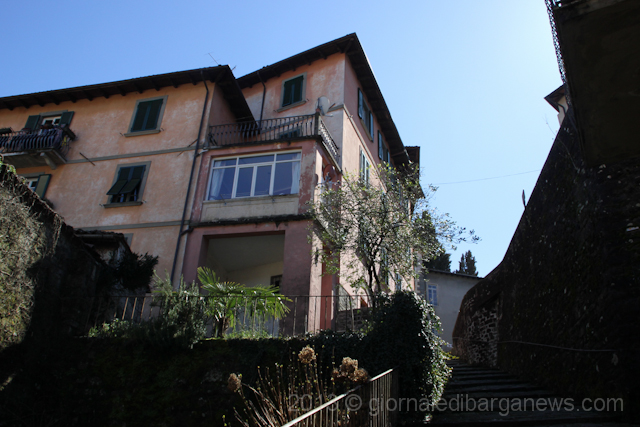
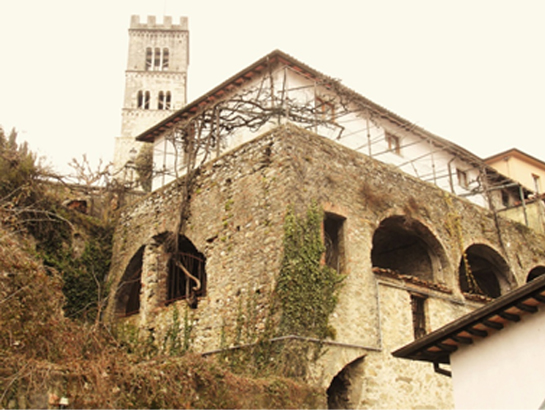
Let us begin this journey with the building that stands alongside the Conservatory of St Elizabeth (see photo), directly opposite the Belvedere care home.
When I was a boy, and for many years afterwards, this building was in a semi-ruined state due to American bombing during the period of the Gothic Line, when the Second World War front remained for many months in our mountains.
Barga lay at the centre of that front: German forces and their Italian allies of the Monterosa division were positioned on the mountains to the north, while the Americans and their allies were to the south. Every American advance was preceded by heavy aerial bombardment, causing immense damage to both property and lives. The area around the Conservatory was particularly affected, and among the buildings damaged was this one.
After the war, as civilian life resumed, the children of that time would venture—despite the danger of collapsing structures—into these damaged and effectively abandoned houses, spending much of their time there in games, of course forbidden by their parents. My generation was no exception.
There was much to fascinate: perhaps discovering a room with a painted ceiling still intact, or feeling like temporary masters of a ruined building filled with debris, playing hide-and-seek among the remains. While wandering from one floor to another, some—not myself—came across a kind of gallery. In the part of the building facing Via del Pretorio, opposite Palazzo Poli, it seemed to lead towards the garden of the Conservatory of St Elizabeth (now part of the Belvedere complex), or towards the nearby Tower—now reduced to little more than a trace due to neglect. This was the Tower where the people of Barga once stored their weapons: rifles, cannons, shot, gunpowder, and more. Today it lies within the property of the old Gramigna house, formerly Bertacchi.
Some of the more daring boys entered the passage for about ten metres, as Ugo Borghesi recalls; others say it ended in a collapse or obstruction. Those waiting outside for the explorers’ return listened eagerly to their accounts, nurturing within themselves the desire to find the courage to venture inside.
This dangerous game continued until parents intervened directly, even alerting the municipal guards, thus putting an end to their children’s exploratory ambitions and, in part, preventing access to the ruin itself.
Another memory of galleries comes from Palazzo Poli itself, formerly Tallinucci. From the ground floor on Via del Pretorio, it is said that a tunnel once led southwards towards the Conservatory garden or the Tower of Arms of the Comune—perhaps a continuation of the previously mentioned gallery, or another connected to it.
These ancient links may have allowed the inhabitants of Barga, when under siege or confronted by invaders within the Castello, to reach the outside of the walls unseen—either beneath the Conservatory of St Elizabeth or to the fortified Tower, where weapons were stored.
This essential military structure was, it seems, also reachable through a secret gallery starting from Porta Reale, on the left-hand side just inside, in the corner formed with the building that now houses a pizzeria. This ascending passage may have followed the line of the walls along the Fosso, or after a stretch diverged to reach the Tower more directly.
I personally remember seeing the beginning of this gallery inside that building, at ground level beside Porta Reale, where the Biagiotti blacksmiths—known as “Picchietto”—once worked. Some claim to have walked part of it, describing it as completely dark and thick with cobwebs.
Another story told to me in recent days concerns the supposed existence of an underground passage linking Porta Reale to Porta Macchiaia, passing beneath Via di Mezzo.
A section of this may have already been mentioned in a previous article, where reference was made to the gallery connecting Palazzo Bertacchi (now Casa Cordati) to Palazzo Angeli—dozens of metres apart—according to the account given by archaeologist Antonio Mordini to Commendator Pietro Marroni.
It is therefore possible that the passage described by Mordini was only part of a longer underground route extending from Porta Reale to Porta Macchiaia, perhaps even branching midway towards Porta di Borgo—the three gateways that might be considered the “three mouths” of Barga, crucial defensive points that could be reached in secrecy.
Another testimony comes from Roberta Popolani, who reports that in the small Gherardi chapel within the school complex of Barga there is an empty tomb from which a tunnel is said to begin, leading directly to the Gherardi family residence—Villa Gherardi—located a short distance away.
In conclusion, it must be said that within the houses of the Castello of Barga, at ground level, there exist—or once existed—various structures suggesting access downwards, such as stairways and similar features. These are clear signs that beneath the surface lies a mystery that these articles have attempted to bring to light.
What has been recounted here consists of my own memories, along with those of people from the past and present who have shared their knowledge, written with the sole aim of preserving an important part of Barga’s collective memory.
In the hope that this simple reconstruction may inspire more serious investigation, we look ahead to a second series of the Mysteries of Barga, where we will examine that curious structure (see photo) beside the final section of the Teatro dei Differenti—built against a slope and rising to the level of Piazza Beato Michele—likely the remains of an ancient internal defensive wall.
—– article by Pier Giuliano Cecchi
Underground Barga 1 – what lies beneath us?
Underground Barga 2 – the passageways of Casa Groppi, Casa Ricci and Via di Solco
Underground Barga 3 – the mysteries of Palazzo Giannetti and Via Marconi
Underground Barga 4 – the passageways of Piazza Angelio and the Augustinians
Underground Barga 5 – readers’ accounts




Con l’uscita del primo articolo sui Misteri di Barga diverse persone di Barga, oltre a compiacersi per l’idea di averli proposti, al tempo stesso me ne hanno suggerito altri, sempre attinenti ai cunicoli, qualcuno aggiungendo e rafforzando la cosa con l’espressione: sotto Barga, il Centro Storico, “è tutto un groviera”. Allora, credo interessante proporre le cose che mi sono state dette e che contribuiscono ad aumentare il fascino del discorso intrapreso.
Partiamo per questo viaggio iniziando da quel palazzo che sta su un fianco del Conservatorio di S. Elisabetta (nella foto), precisamente di fronte alla Casa di Riposo Belvedere.
Quando ero ragazzo, ma anche per diversi anni dopo, questo casamento era in uno stato di semi-distruzione a causa dei bombardamenti americani avvenuti nel periodo della Linea Gotica, quando il fronte della Seconda Guerra Mondiale si fermò per lunghi mesi tra i nostri monti.
Barga si trovava al centro di quel fronte di guerra, che vide i Tedeschi e gli alleati italiani della Monterosa, ecc., situati sui monti a nord, mentre gli americani e suoi alleati a sud. Ogni azione americana d’avanzamento era sempre preceduta da un più che consistente bombardamento aereo, causa di moltissimi danni a cose e persone. La zona del Conservatorio fu particolarmente bombardata e tra i danni riscontrati, ci fu anche il palazzo in questione.
Terminata la guerra e ripresa la vita civile, i ragazzi d’allora si avventuravano, non senza pericolo per i crolli che potevano avvenire di strutture precarie, in queste case rimaste danneggiate e, di fatto, abbandonate, lì trascorrendo gran parte dei loro giochi, ovviamente proibiti dai genitori. Così fu anche per la mia generazione.
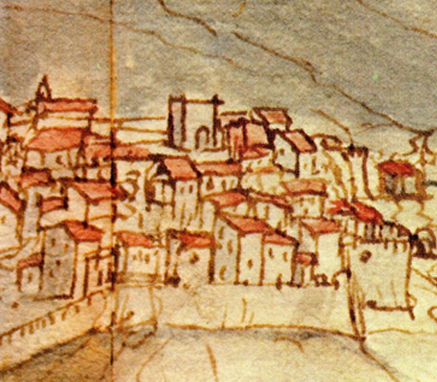
Barga nel 1539. Al centro, ingrandita, la torre delle armi
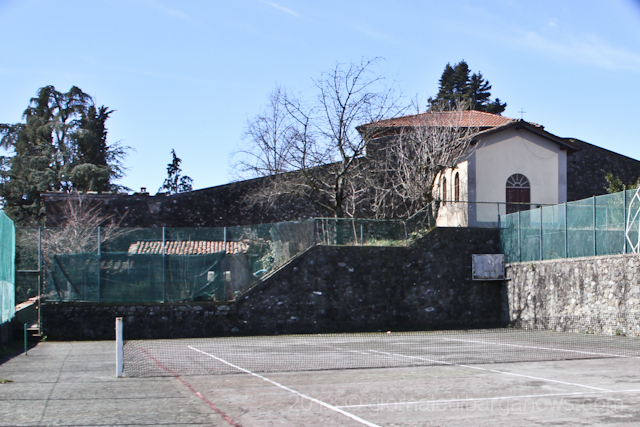
Tante erano le cose che affascinavano: magari la scoperta di una stanza ancora dipinta nel soffitto, oppure sentirsi temporanei padroni di un sia pur rudere pieno di macerie e lì giocare a rimpiattino e altro. Nel girovagare tra un piano e l’altro ecco lo imbattersi, non mio, in una sorta di galleria, che nella parte del palazzo prospicente via del Pretorio e che guarda il palazzo Poli, andava in direzione dell’orto del Conservatorio S. Elisabetta (oggi nelle pertinenze della Casa di riposo Belvedere) o della vicina Torre, anch’essa, però per cause naturali dovute all’abbandono, ormai ridotta a più che un sembiante. Quella era la Torre dove i barghigiani tenevano custodite le armi: fucili, cannoni, palle, polvere da sparo e altro; oggi nei possedimenti dell’antica casa Gramigna, in passato Bertacchi.
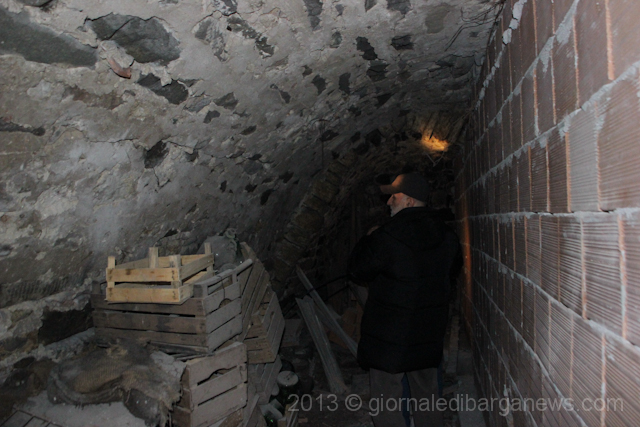
Qualcuno dei più ardimentosi vi s’introdusse per circa 10 metri, così come ricorda Ugo Borghesi; altri dicono che s’interrompesse a un presunto franamento o qualcosa del genere. Chi era rimasto fuori ad aspettare il ritorno degli esploratori attendeva con ansia le notizie, il racconto dei misteri incontrati, covando in sé l’idea della ricerca del coraggio per introdurvisi a sperimentarli.
Questo pericoloso gioco durò sino al diretto intervento dei genitori che avvisano anche le guardie comunali, insieme ponendo fine ai sogni esplorativi dei figli, in parte riuscendo anche a vietare l’accesso allo stesso rudere.
il luogo dove sorgeva la Torre: dietro la cappellina presso il campo da gioco del conservatorio
Altra memoria di gallerie ci viene dallo stesso Palazzo Poli, in antico Tallinucci, dove al piano terra di via del Pretorio, si narra partisse una galleria diretta sempre a sud, ossia verso l’orto del Conservatorio S. Elisabetta o alla Torre delle Armi del Comune, possibile seguito della precedente galleria o altra a essa collegata.
Antichi collegamenti che consentivano ai barghigiani assediati o magari alle prese con invasori per le vie del Castello o Terra di Barga, di poter comunque, in incognito, raggiungere l’esterno delle mura che erano sotto il Conservatorio di S. Elisabetta, oppure la fortificata Torre, dove avrebbero trovato le armi e altro.
Questa struttura militare di essenziale vitalità pare si potesse raggiungere, sempre segretamente, tramite una galleria che partiva da Porta Reale, sul fianco sinistro all’interno, nell’angolo che fabbrica con la casa che ospita una pizzeria. Una struttura a salire che avrebbe dovuto fiancheggiare le mura del Fosso, oppure lasciandole dopo un tratto, così raggiungendo più direttamente la Torre delle Armi.
Personalmente ricordo di aver visto all’interno di quella casa l’inizio della galleria, precisamente nel piano terra attaccato a Porta Reale che ospitava i fabbri Biagiotti, detti Picchietto. Qualcuno narra di averla percorsa per un tratto, dicendo fosse stata, ovviamente buia e strapiena di ragnatele.
Una galleria trasversale a via di mezzo nei fondi di un antico palazzo
Altra cosa raccontatami in questi giorni è la creduta esistenza di una galleria sotterranea che pare collegasse, tramite via di Mezzo, Porta Reale con Porta Macchiaia.
Una presunta parte di essa l’abbiamo citata in una precedente puntata, dove si parla della galleria che collegava Palazzo Bertacchi (ora casa Cordati) a Palazzo Angeli, distanti tra loro decine di metri, esattamente nella memoria fatta al Comm. Pietro Marroni da parte dell’archeologo Antonio Mordini che l’aveva praticata diverse volte sino alla chiusura del suo accesso.
In pratica potrebbe essere che la galleria, diciamo Mordini, altro non fosse una parte di un più lungo camminamento sotterraneo che partisse da Porta Reale per raggiungere Porta Macchiaia, e magari a metà percorso, scendere anche a Porta di Borgo, le tre porte che potremmo definire le tre bocche di Barga, i punti di estrema protezione da raggiungersi anche in incognito.
Altra testimonianza di un antico passaggio ce la fornisce Roberta Popolani la quale ci segnala che nella chiesina dei Gherardi presente presso il complesso scolastico di Barga c’è una tomba, oggi vuota, da cui partirebbe una galleria che direttamente raggiunge il palazzo della famiglia ricordata.
Si tratta di Villa Gherardi, distante dalla cappellina alcune decine di metri.
In chiusura ripetiamo che nelle case del Castello di Barga, nelle parti a terra, esistono o sono state occultate diverse strutture degli accessi a scendere con scale o similari, segno evidente che nel sottosuolo si cela ancora oggi un mistero che i presenti articoli hanno cercato di sollevare.
Ovviamente quanto abbiamo raccontato sono ricordi miei, di persone del passato e presenti che mi hanno suggerito alcune cose, scritte con l’unico intento di non perdere un’importante memoria di Barga.
Con la speranza che questa semplice ricostruzione possa stimolare attenzioni ben più importanti, lanciamo da ora l’appuntamento alla seconda serie dei misteri di Barga, in cui parleremo di quella strana costruzione (nella foto) a fianco della parte finale del Teatro Differenti, che addossandosi a uno sbalzo del terreno sale sino all’altezza di piazza Beato Michele, è il probabile resto di un’antica cinta muraria interna.
—– article by Pier Giuliano Cecchi
Underground Barga 1 – what lies beneath us?
Underground Barga 2 – the passageways of Casa Groppi, Casa Ricci and Via di Solco
Underground Barga 3 – the mysteries of Palazzo Giannetti and Via Marconi
Underground Barga 4 – the passageways of Piazza Angelio and the Augustinians
Underground Barga 5 – readers’ accounts